
Breaking Up With Your Oil Tank for Good

Is Converting From Oil to Electric Heat Worth It in 2026?
Is converting from oil to electric heat worth it — and the short answer is yes, for most homeowners it is. Here's a quick breakdown:
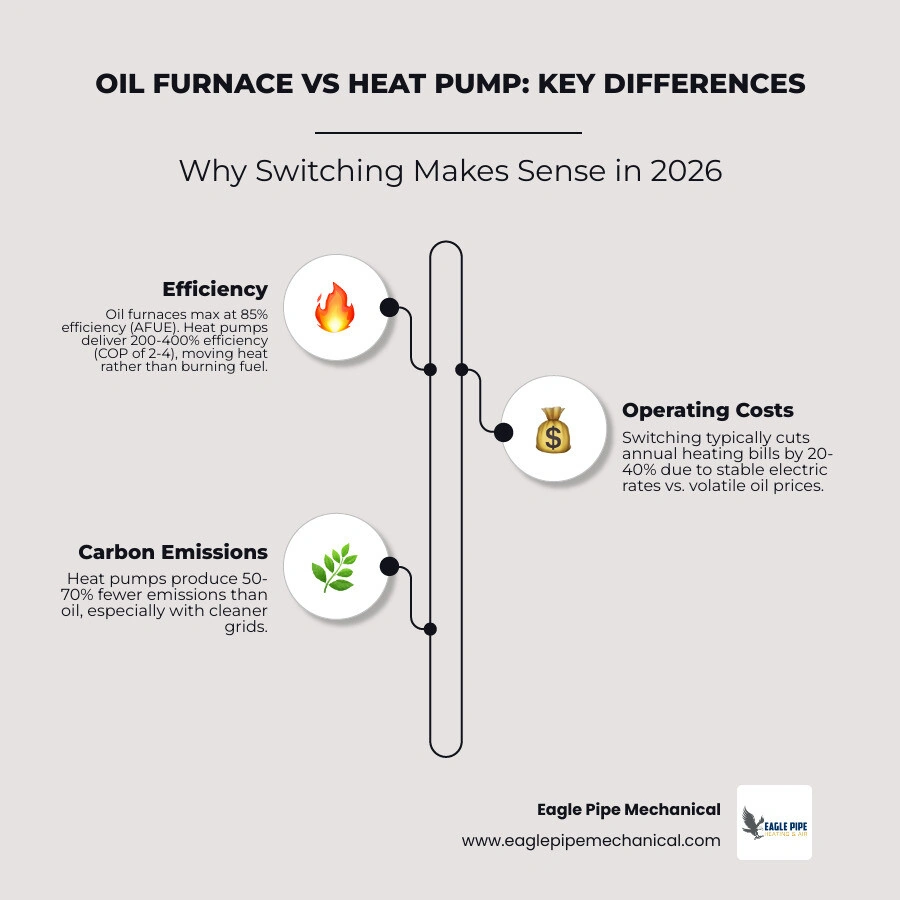
- Efficiency: Heat pumps deliver 2–4 units of heat for every unit of electricity used, compared to an oil furnace's roughly 85% efficiency ceiling
- Operating costs: Homeowners who switch typically see 20–40% lower annual heating bills
- Environmental impact: Heat pumps produce 50–70% fewer carbon emissions than oil heating
- Dual function: One system handles both heating and cooling, replacing two appliances
- Incentives: Federal and state rebates can significantly offset upfront conversion costs
- Volatility: Electric rates are far more stable than heating oil prices, which swing with global events
If you heat your home with oil in Kitsap or Jefferson County, Washington, you already know the feeling — that low-grade anxiety every time an international news headline threatens to push fuel prices higher. Heating oil doesn't care about your budget or your thermostat. Global supply disruptions, seasonal demand spikes, and delivery logistics all sit between you and a warm house. Meanwhile, modern electric heat pumps have quietly become one of the most efficient home heating technologies available, and in the mild Pacific Northwest climate, they perform exceptionally well. This guide breaks down the real financial case for making the switch, so you can decide with confidence.
As we move through 2026, the case for Heat pumps vs. oil furnace heating: What’s better in 2026? | EnergySage becomes clearer every day. For the past four years, heat pumps have been the most-shipped heating appliance in the United States, officially outselling gas and oil furnaces. This isn't just a trend; it's a structural shift in how we power our homes.
When we look at the future-proofing aspect, electric heat offers a level of energy independence that oil simply cannot match. While oil prices are tied to global market volatility—where a single conflict thousands of miles away can send your monthly heating bill skyrocketing—electricity is increasingly generated locally through renewable sources. Furthermore, a well-maintained heat pump system typically boasts a comparable lifespan to an oil furnace but provides the added benefit of high-efficiency air conditioning during our increasingly warm Washington summers. If you are tired of the "oil price roller coaster," More info about oil to electric services can show you the path toward a more predictable, stable home budget.
The Financial Logic: Efficiency and Operating Costs
To understand why so many of our neighbors in Poulsbo and Silverdale are making the switch, we have to look at the physics of heating. An oil furnace creates heat by burning fuel. Even the most advanced modern oil furnaces hit an efficiency ceiling of about 85% to 90% AFUE (Annual Fuel Utilization Efficiency). This means for every dollar you spend on oil, at least 10 to 15 cents literally goes up the chimney as exhaust.
In contrast, a heat pump doesn't create heat; it moves it. Even in cold weather, there is ambient heat in the outdoor air. By using a refrigerant cycle, the system gathers that heat and moves it indoors. This allow heat pumps to achieve 200% to 400% efficiency. In technical terms, this is a "Coefficient of Performance" (COP) of 2.0 to 4.0. For every one unit of electricity used, you get up to four units of heat. This thermodynamic advantage is the primary reason why Going green: Switching from oil or propane to electric heat can often save money | ACEEE is a reality for the vast majority of residential retrofits.
When we calculate the seasonal performance factor, heat pumps consistently outperform fossil fuel burners. While some homeowners consider an oil furnace to gas conversion, the long-term trend is leaning heavily toward full electrification because it eliminates the need for any combustible fuel on the property.
Why converting from oil to electric heat is worth it for Washington homeowners
In Kitsap and Jefferson Counties, we are blessed with a relatively mild maritime climate. This is the "sweet spot" for heat pump technology. Unlike the extreme sub-zero temperatures found in the Midwest, our winters rarely stay below freezing for extended periods. This means your heat pump can operate at its peak efficiency for almost the entire heating season.
Our local utility rates in areas like Port Orchard and Bremerton generally make electricity a more cost-effective "fuel" than delivered heating oil. Additionally, because a heat pump is a two-in-one system, you gain whole-home air conditioning. In the past, many Washington homes didn't need cooling, but as our summers get smokier and hotter, the ability to close the windows and enjoy filtered, cool air is a massive lifestyle upgrade. If you've been looking into an oil to propane conversion, it's worth weighing that against the 100% electric route, which removes the need for any fuel deliveries or tank monitoring whatsoever.
Is converting from oil to electric heat worth it for older homes?
We often hear from homeowners in historic Port Townsend or older neighborhoods in Kingston who worry their drafty homes aren't "ready" for a heat pump. It is true that the efficiency of any system depends on the "thermal envelope" of the house. Before we install a new system, we look at:
- Insulation levels: Is the attic properly insulated?
- Ductwork integrity: Are the existing ducts leaky? (If so, ductless mini-splits might be a better option).
- Air sealing: Are there major drafts around windows and doors?
- Electrical panel capacity: Most heat pumps require a 200-amp electrical service. If your home still has an old 60-amp or 100-amp panel, an upgrade will be part of the conversion process.
While an oil to gas conversion is sometimes an option if a gas line is already at the curb, the electric route is often more accessible for rural properties and offers better long-term "future-proofing" against carbon taxes or fossil fuel phase-outs.
Performance Realities: Heat Pumps in the Pacific Northwest
One of the biggest myths we encounter is that heat pumps don't work when it gets cold. That might have been true in 1985, but 2026 technology is a different beast entirely. Modern "cold-climate" heat pumps are designed to provide 100% heating capacity down to 5°F and continue operating effectively even at -15°F.
These systems use variable-speed compressors that "sip" energy rather than clanging on and off like an old oil furnace. During a rare Kitsap County deep freeze, the system may enter a "defrost cycle" to clear ice from the outdoor coils—this is perfectly normal and usually only lasts a few minutes. For those who want absolute peace of mind, we can install backup electric heat strips or design a "hybrid" dual-fuel system that keeps your existing furnace (if it's still in good shape) as an emergency backup for those three days a year when the temperature bottoms out.
The Conversion Roadmap: Tanks, Panels, and Ductwork
Breaking up with your oil tank is a process, but we handle the heavy lifting. The conversion usually follows a specific roadmap:
- Oil Tank Removal: Whether it’s an aboveground tank in the basement or a buried tank in the yard, professional removal is essential. For buried tanks, we ensure proper soil testing is conducted to protect your property value and the environment.
- Electrical Heavy-Up: As mentioned, we often upgrade the home to a 200-amp service to handle the new heating load and future-proof the home for EV chargers or other electric appliances.
- Asbestos Abatement: In some older homes in places like Port Ludlow, old boiler pipes may have asbestos insulation. We ensure this is handled safely by certified professionals.
- Hydronic Transitions: If you currently have an oil boiler with radiators, we can explore air-to-water heat pumps or transition the home to a high-efficiency ductless system, which allows for individual "zones" in different rooms.
Our NATE-certified technicians are familiar with the specific local codes in Port Townsend, Gig Harbor, and throughout the Peninsula, ensuring your installation is permitted and safe.
Environmental Benefits and Future-Proofing
Switching to electric heat is one of the single most impactful things a homeowner can do for the planet. In Washington, our electrical grid is among the cleanest in the nation, relying heavily on hydro, wind, and solar. By moving from oil to a heat pump, you can reduce your home's direct carbon emissions by 50% to 70% almost overnight.
Beyond the "green" factor, there is a "gold" factor: home resale value. In 2026, buyers are increasingly wary of homes with oil tanks. They see them as environmental liabilities and expensive relics. A home with a high-efficiency heat pump—especially one paired with solar panels—is significantly more attractive to the modern buyer. Furthermore, you’ll enjoy better indoor air quality by eliminating the combustion gases, soot, and "oil smell" that often linger in homes with older furnaces. For communities with strong sustainability goals like Bainbridge Island, this switch is a major step toward a cleaner local environment.
Frequently Asked Questions
What is the typical payback period for an oil-to-electric conversion?
While every home is different, the typical payback period ranges from 8 to 15 years. However, when you factor in current federal tax credits and local utility rebates, that ROI often accelerates. Think of it as a "fuel hedge"—you are prepaying for years of lower energy bills by investing in efficient equipment today.
Do I need to remove my old oil tank to switch to electric?
In almost every case, yes. An unused oil tank is a liability. Aboveground tanks can rust and leak, while abandoned underground tanks can complicate future home sales or insurance renewals. Most property insurance companies now require the removal or professional "decommissioning" of oil tanks to maintain coverage.
Will a heat pump keep my home warm during a Kitsap County cold snap?
Absolutely. By using "hyper-heating" technology and proper system sizing, we ensure your home stays toasty even when the frost is thick on the windows. We perform a detailed "Manual J" load calculation for every home to ensure the system is perfectly matched to your space's specific needs.
Conclusion
At Eagle Pipe Mechanical, we’ve spent over 45 years helping our neighbors across Kitsap and Jefferson Counties stay comfortable. As a 100% women-owned and operated business, we take a personable, honest approach to every project. We aren't just here to sell you a box; we're here to find the solution that fits your life in Poulsbo, Bainbridge Island, or Port Orchard.
From our 37-point Eagle's Nest maintenance inspections to our flexible Synchrony financing options, we make the transition to electric heat as smooth as possible. We serve families from Hansville to Gig Harbor and everywhere in between, focusing on energy efficiency and long-term satisfaction.
Ready to stop worrying about the oil truck and start enjoying efficient, year-round comfort? Schedule your oil to electric conversion today and let us help you break up with your oil tank for good.
CUSTOMER TESTIMONIALS
Our customers’ experiences say more than we ever could. See how Eagle Pipe Heating & Air has earned trust across the Pacific Northwest with reliable service and lasting results.