Beginner's Guide to How Kitsap Peninsula Climate Affects Your Home Systems

Why the Kitsap Peninsula's Marine Climate Is Hard on Your Home Systems
How Kitsap Peninsula climate affects your home systems is something most local homeowners discover the hard way — through a corroded HVAC coil, a backed-up drain after a heavy November rain, or stubborn indoor humidity that just won't quit no matter the season.
Living in Kitsap or Jefferson County means living in one of the most beautiful — and uniquely demanding — climates in the country. The region sits in IECC Climate Zone 4C, a Mixed-Marine classification that brings 40 to 50 inches of rain per year, persistent coastal humidity, salt-laden air off Puget Sound, and mild but damp winters that run roughly October through March. That combination puts quiet, steady pressure on your HVAC equipment, plumbing lines, and indoor air quality in ways that a dry inland climate simply does not.
Here is a quick summary of the main ways the Kitsap Peninsula's climate puts stress on your home systems:
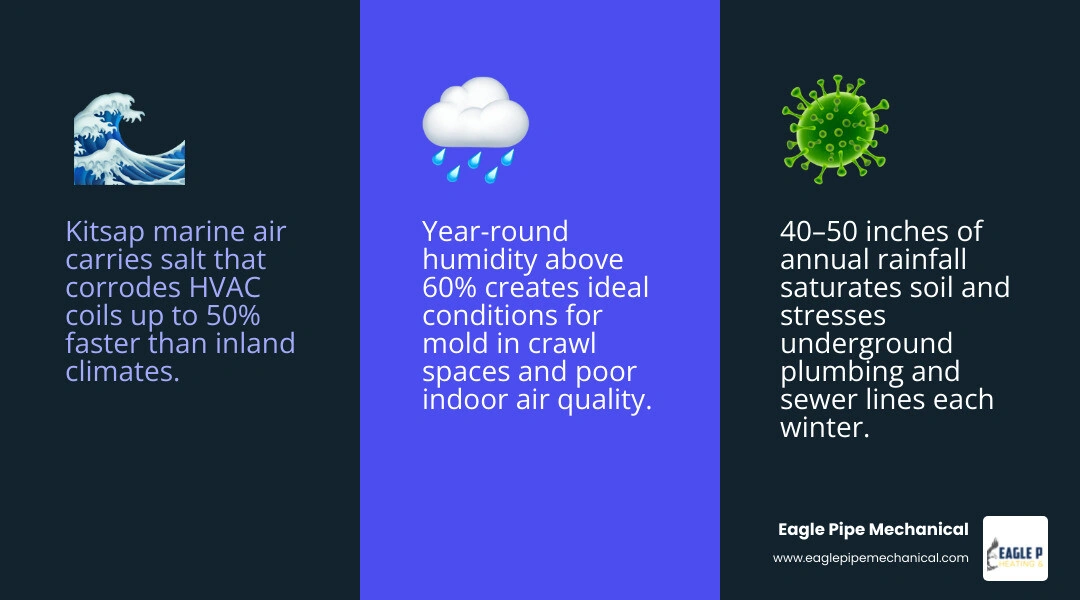
- Salt air and coastal humidity cause electrochemical corrosion on outdoor HVAC coils, reducing efficiency by up to 50% and shortening system lifespan from 15-20 years down to as little as 10 years without proper protection
- 40-50 inches of annual rainfall saturates the ground, stressing underground plumbing, sewer lines, foundation drains, and septic systems — especially between October and March
- Year-round indoor humidity creates conditions for mold growth, poor indoor air quality, and moisture damage in crawl spaces and attics
- Mild but damp winters make heat pumps the most efficient heating choice, but those same systems need climate-specific maintenance to survive the marine environment
- Occasional cold snaps and heat dome events mean your systems need to handle a wider range of conditions than the "mild" reputation of the region might suggest
This guide walks you through each of these factors in plain language — what is happening, why it matters, and what you can do about it.
Marine Air and Salt Corrosion: How Kitsap Peninsula Climate Affects Your Home Systems
If you live anywhere near the shoreline in communities like Bainbridge Island, Kingston, Port Townsend, or Suquamish, you are likely familiar with the refreshing breeze coming off the water. However, that breeze carries a invisible passenger: microscopic salt-laden moisture.
When this salt air passes through the outdoor condenser unit of your air conditioner or heat pump, it initiates a destructive process known as galvanic corrosion. This electrochemical reaction occurs when two dissimilar metals—such as the aluminum fins and copper tubing in your HVAC system's coils—come into contact with an electrolyte, which in this case is the damp, salty marine air.
Over time, this corrosion creates a crusty, insulating layer of oxidation over the metal surfaces. This layer acts as a barrier, preventing the coils from efficiently releasing or absorbing heat. Research indicates that coastal salt air can reduce HVAC system efficiency by up to 50% if the coils are not regularly maintained. As the system struggles to transfer heat, it has to run longer and work harder, which spikes your monthly energy bills and accelerates the wear and tear on internal components.
Furthermore, as climate patterns shift, our local environment is experiencing changes that compound these issues. According to the Climate Change in Kitsap County resiliency assessments, our region is facing warmer average temperatures and more frequent extreme weather events. These climate shifts mean outdoor HVAC units are running more hours out of the year to provide cooling during summer heatwaves, exposing already vulnerable, salt-damaged components to prolonged operational stress.
How Kitsap Peninsula Climate Affects Your Home Systems via Salt Air Corrosion
The physical toll of galvanic corrosion on your outdoor heat pump or air conditioner is highly predictable. The thin aluminum fins on the condenser coil will begin to pit, flake, and turn into a white, powdery residue. As these fins degrade, they lose their physical connection to the copper tubing inside. This loss of surface area directly cripples the unit's heat transfer capacity.
In advanced stages, the corrosion eats deep enough into the copper tubing to create tiny pinhole refrigerant leaks. Once refrigerant begins to leak, your system will experience:
- Uneven indoor temperatures and poor dehumidification
- Short-cycling (turning on and off rapidly)
- Ice buildup on the outdoor or indoor coils
- Total compressor failure (which is often a system-ending event)
While a well-maintained heat pump in our region typically lasts 15 to 20 years, neglected units in waterfront or near-coastal areas can fail in as little as 10 years due to salt air corrosion.
Fortunately, you do not have to let salt air destroy your investment. To protect your system, we highly recommend choosing the Best HVAC Setup for the Olympic and Kitsap Peninsula, which includes specifying marine-grade anti-corrosion coatings (such as Gold Fin or Blue Fin technology) on any new outdoor installations.
For existing units, the most effective DIY defense is a regular, gentle freshwater rinse. Once a month, use a standard garden hose with a gentle spray nozzle to rinse the salt accumulation off your outdoor coils. Never use a high-pressure pressure washer, as this will easily bend and ruin the delicate aluminum fins.
Rainfall, Humidity, and Saturated Ground: Plumbing and IAQ Challenges
Kitsap County receives between 40 to 50 inches of annual rainfall, with the vast majority of it concentrated between October and March. This relentless winter downpour does more than just make the landscape look beautifully green—it completely saturates the soil.
Saturated ground creates immense hydrostatic pressure against your home’s foundation, crawl space, and underground utility lines. This heavy moisture load is a primary driver behind local plumbing failures, sewer backups, and compromised indoor air quality (IAQ). When the soil can no longer absorb water, that excess runoff has to go somewhere, and if your home's drainage systems are not prepared, it will find its way into your living spaces.
According to data from the Climate & The Environment - Kitsap Public Health District, persistent dampness and poor moisture control inside homes are directly linked to respiratory issues, allergen proliferation, and mold growth. Because our region experiences high relative humidity year-round, keeping indoor moisture levels managed is not just a matter of structural preservation—it is a critical public health priority for you and your family.
How Kitsap Peninsula Climate Affects Your Home Systems through Moisture and Drainage
When the ground around your home becomes waterlogged, your plumbing and drainage systems are put to the test. If you start noticing slow drains or hearing strange gurgling sounds from your toilets during a heavy storm, it is a sign that the saturated ground is impacting your waste lines.
Here is how high rainfall and saturated soil trigger hidden problems:
- Sewer Line and Septic Stress: Saturated soil can cause the ground to shift, which puts physical stress on buried sewer lines. If your pipes have minor cracks or loose joints, rainwater can seep in (a process called inflow and infiltration), overwhelming your sewer line or septic tank. This often leads to sluggish drains or, in worst-case scenarios, raw sewage backing up into your lowest household drains.
- Crawl Space and Foundation Moisture: High water tables push moisture upward through soil into unsealed crawl spaces. This rising vapor elevates the relative humidity under your home, creating the perfect breeding ground for wood rot, structural decay, and mold.
- Aggressive Tree Root Intrusion: Pacific Northwest trees love water, and during dry summer spells, their root systems actively seek out moisture. Any minor crack or joint separation in an underground sewer line acts as an attractive water source. Roots will grow into these openings, creating massive blockages that become completely clogged when heavy winter rains arrive.
To understand how these forces interact beneath your floors, you can read about the Hidden Plumbing Problems in Pacific Northwest Homes and learn exactly How Tree Roots Damage Plumbing in the Pacific Northwest.
To combat the indoor humidity that rises from wet crawl spaces and saturated soils, your HVAC system must play an active role. You can explore How Your HVAC System Prevents Mold in Wet Climates to see how modern air-source systems manage moisture. Additionally, understanding How Moisture from a Hidden Leak Contributes to Mold in PNW Homes will help you spot early warning signs before a small plumbing drip turns into an expensive mold remediation project.
Choosing the Best Heating and Cooling Systems for Climate Zone 4C
Kitsap County falls squarely within IECC Climate Zone 4C (Mixed-Marine). This means we experience relatively mild winters (with design temperatures rarely dropping below 29°F) and mild, though increasingly warm, summers. To meet local energy codes (IECC 2021), homes in our zone must meet strict efficiency benchmarks, including minimum insulation levels of R-49 for ceilings, R-20 for walls, R-19 for floors, and windows with a maximum U-factor of 0.32 and a Solar Heat Gain Coefficient (SHGC) of 0.4.
Because roughly 25% to 30% of residential energy loss and gain occurs directly through windows, our heating and cooling systems must work in tandem with our home's insulation. During our humid summers, solar heat gain can trap warmth indoors, forcing cooling systems to run longer. This is why many Kitsap homeowners install exterior solar screens, which can intercept 80% to 90% of solar radiation, or upgrade to Low-E glass to reduce annual cooling costs by 10% to 30%.
When it comes to selecting the actual equipment to heat and cool a Zone 4C home, traditional systems like electric resistance baseboards or standard gas furnaces are no longer the most practical or cost-effective choices. Instead, heat pumps and ductless mini-splits have become the regional gold standard.
A modern air-source heat pump does not burn fuel to create heat; instead, it uses electricity to move heat from the outdoor air indoors during winter, and reverses the process in the summer. Because our winter temperatures hover in the highly efficient 40°F to 50°F range for about 70% of the heating season, heat pumps can achieve thermodynamic efficiencies of 300% to 400%—meaning they deliver three to four times more heat energy than the electrical energy they consume.
| System Type | Typical Efficiency (COP / AFUE) | Duct Energy Loss | Best Suited For | Key Climate Advantage |
|---|---|---|---|---|
| Ductless Mini-Split | Up to 400% (COP 4.0) | 0% (No ducts) | Homes without ductwork, zone heating, additions | Eliminates duct energy loss; superior localized dehumidification |
| Ducted Heat Pump | 300% - 350% (COP 3.0+) | 20% - 30% (If leaky) | Homes with existing ductwork, central heating | Extremely efficient in mild 4C winters; provides central cooling |
| Electric Furnace | 100% (COP 1.0) | 20% - 30% | Small apartments, backup heating | Low install cost, but extremely expensive to operate in winter |
For homeowners looking to maximize their Home Energy Efficiency, upgrading to a heat pump is the single most impactful step you can take. To explore how these systems deliver reliable, year-round comfort while lowering your utility bills, check out our guide on the Heat Pump Benefits for Pacific Northwest Homeowners.
Frequently Asked Questions about Kitsap Home Systems
How often should I service my heat pump in Kitsap County?
You should have your heat pump professionally serviced twice a year—once in the spring before the cooling season starts, and once in the fall before the winter dampness sets in.
Because heat pumps in the Pacific Northwest run year-round to provide heating, cooling, and active dehumidification, they accumulate double the wear of a standard furnace. Seasonal maintenance ensures that electrical connections are tight, refrigerant levels are correct, and the defrost cycle is calibrated properly to prevent outdoor coil freeze-ups during cold, wet snaps.
Regular maintenance is also your best defense against unexpected weather. To learn more about how regional storm patterns can impact your outdoor equipment, read our guide on How Pacific Northwest Storms Affect Your HVAC System.
Does salt air really damage my outdoor AC unit?
Yes, absolutely. The microscopic salt particles carried by the marine air deposit onto the aluminum fins and copper tubes of your outdoor unit. This leads to galvanic corrosion, which degrades the metal, reduces heat transfer efficiency by up to 50%, and eventually causes costly refrigerant leaks.
To prevent this, you should perform a monthly freshwater rinse of the coils and ensure you have at least two feet of clear space around the unit for proper airflow. Professional maintenance is also critical for applying protective coatings and deep-cleaning the coils safely. For more information on how maintaining your outdoor and indoor systems helps prevent moisture-related issues, read about How Proper HVAC Maintenance Prevents Mold Growth.
What are the best ways to prevent plumbing backups during heavy winter rains?
The most effective ways to prevent plumbing backups during Kitsap's heavy winter rains include:
- Schedule a Sewer Camera Inspection: This allows us to look inside your sewer line to spot minor cracks, offset joints, or early tree root intrusions before they cause a major backup. Learn more about How Often Should a Sewer Line Be Inspected in the Pacific Northwest.
- Keep Gutters and Downspouts Clear: Ensure your gutters are free of pine needles and leaves, and verify that downspouts discharge water at least 5 to 10 feet away from your home's foundation to prevent soil oversaturation.
- Maintain Good Drain Habits: Avoid putting grease, oils, wet wipes, or harsh chemical drain cleaners down your plumbing. To keep your waste lines running smoothly year-round, check out our tips on How to Keep Drains Clear in a High Rainfall Climate Like Puget Sound.
Conclusion
Understanding how kitsap peninsula climate affects your home systems is the first step toward protecting your property, lowering your monthly energy bills, and ensuring your indoor spaces remain healthy and comfortable. From salt air corrosion on Bainbridge Island to saturated soils in Poulsbo and Silverdale, our unique marine climate demands proactive, expert care.
At Eagle Pipe Mechanical, we are proud to be a trusted HVAC and plumbing contractor serving Kitsap and Jefferson Counties. As a 100% women-owned and operated business with over 45 years of experience, we bring a personable, solutions-oriented approach to every home we visit. Whether you need a high-efficiency heat pump installation, a sewer line inspection, or a comprehensive indoor air quality solution, our team is committed to providing honest, efficient, and knowledgeable service.
To give our clients complete peace of mind, we offer the Eagle's Nest maintenance plan, which includes:
- Thorough 37-point system inspections
- Extended equipment warranties
- Priority customer status for scheduled services
- Exclusive discounts on repairs
We also understand that home system upgrades are a significant investment, which is why we provide flexible financing options through Synchrony to help you optimize your home's energy efficiency without breaking the bank. Please note that while we provide comprehensive maintenance and scheduled repair services to keep your systems running flawlessly, we do not offer 24/7 emergency services. We focus on high-quality, scheduled solutions designed to prevent emergencies from happening in the first place.
Ready to protect your home from the Pacific Northwest elements? Check out our Eagle Pipe Mechanical Service Areas to see if we serve your neighborhood, and contact us today to schedule your system check-up!
CUSTOMER TESTIMONIALS
Our customers’ experiences say more than we ever could. See how Eagle Pipe Heating & Air has earned trust across the Pacific Northwest with reliable service and lasting results.