Cheat Sheet to Adding AC for Family Heat Protection

When the Heat Hits Hard: Why Adding AC Is a Family Safety Decision
Understanding how adding ac protects your family during extreme heat could be one of the most important things you do this summer. Here is a quick breakdown:
AC protects your family during extreme heat by:
- Keeping core body temperature safe - A cool indoor environment prevents heat exhaustion and life-threatening heat stroke.
- Protecting vulnerable family members - Children, older adults, and pets cannot regulate body heat the way healthy adults can.
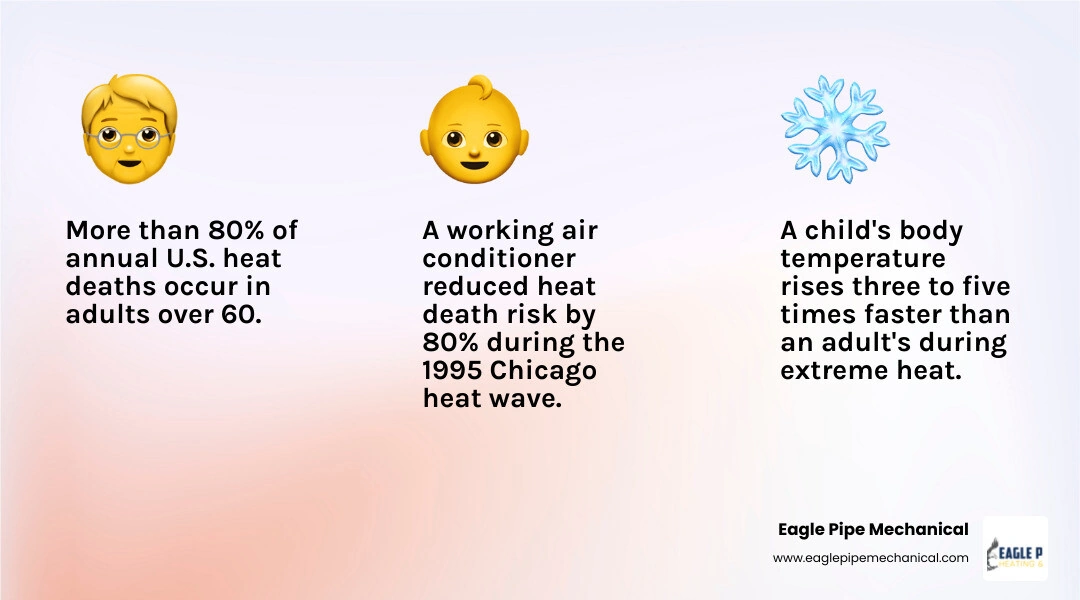
- Reducing heat death risk - Research from the 1995 Chicago heat wave found that a working air conditioner reduced the risk of death by 80%.
- Controlling indoor humidity - AC removes moisture from the air, making high heat far less dangerous.
- Providing a reliable refuge - Unlike fans, AC actively lowers air temperature rather than just moving warm air around.
Extreme heat is one of the leading causes of weather-related deaths in the United States. And the danger is closer than most Pacific Northwest homeowners expect. Heat domes have hit the region hard in recent years, pushing temperatures into triple digits across Kitsap and Jefferson County — conditions that local homes were often not built to handle.
The numbers are sobering. More than 80% of annual U.S. heat deaths occur in adults over 60. A child's body temperature rises three to five times faster than an adult's. And in a 2019 Maricopa County study, 91% of people who died indoors from heat-related causes had air conditioners that were either off, set too high, or broken. Having AC is not enough — it has to actually be running and doing its job.
This guide walks you through everything you need to know: who is most at risk, how AC outperforms every other cooling method, how to keep your system running when temperatures spike, and what to do if it fails.
The Health Risks of Extreme Heat on Vulnerable Loved Ones
When temperatures climb, it is easy to view air conditioning as a simple luxury. However, in the face of modern climate extremes, cooling is fundamentally a safety measure. Human bodies are remarkably good at cooling themselves under normal circumstances, but extreme heat combined with high humidity pushes our biological limits to the brink.
When the heat index rises, the body struggles to shed excess warmth. This can quickly lead to dehydration, heat exhaustion, and heat stroke. Recognizing these risks is the first step in protecting those we care about most. For a comprehensive look at immediate survival strategies, check out NPR's guide on staying cool during heat waves.
Biological Vulnerabilities of Children and Seniors
Our youngest and oldest family members face the greatest physiological dangers during a heat wave.
- Older Adults (Seniors 60+): More than 80% of annual heat-related deaths in the United States occur in adults over the age of 60. As we age, our bodies become less efficient at regulating temperature. Our sweat glands do not work as well, and our cardiovascular systems have to work significantly harder to pump blood to the skin to release heat. Additionally, chronic medical conditions—and the medications used to treat them, such as diuretics or beta-blockers—can severely impair the body's natural ability to hydrate and shed heat.
- Young Children and Infants: A child's body temperature rises three to five times faster than an adult's. Children have a smaller surface-area-to-mass ratio, meaning they absorb environmental heat rapidly but have fewer developed sweat glands to release it. They are also entirely dependent on adults to keep them hydrated and out of hot environments. This biological vulnerability is why hot vehicles are so deadly; interior vehicle temperatures can exceed 115°F in minutes even when it is only 70°F outside. On average, 37 children die each year in the U.S. from vehicular heatstroke.
- Family Pets: Our four-legged companions cannot sweat through their skin; they rely almost entirely on panting to cool down. Brachycephalic (flat-faced) breeds like pugs and bulldogs are especially prone to respiratory failure in high heat. Furthermore, outdoor surfaces become scorching; asphalt can easily reach 130°F to 140°F on a warm 85°F day, which can burn a dog's paws in less than a minute.
How Adding AC Protects Your Family During Extreme Heat by Preventing Heat Illness
Having a reliable, active cooling system is the single most effective way to prevent heat-related medical emergencies. Air conditioning creates an environment where the human body can rest, recover, and shed internal heat without working overtime.
This active cooling keeps core body temperatures below the critical 103°F threshold where heat stroke begins. When you add a dedicated cooling system, you establish a permanent safe zone in your home, eliminating the need to scramble for temporary shelter or public cooling centers when a heat dome settles over the Puget Sound. If you are considering upgrading your home, you can learn more about the advantages of a permanent setup by reading about Expert Central Air Installation Benefits.
How Adding AC Protects Your Family During Extreme Heat Compared to Other Methods
When a heat wave is forecast, many homeowners try to get by using alternative cooling methods. While box fans, ceiling fans, and evaporative coolers have their place, they simply cannot compete with the safety and reliability of a dedicated air conditioning system during extreme weather.
| Cooling Method | Temp Reduction Capability | Humidity Control | Safety at 95°F+ | Best Suited For |
|---|---|---|---|---|
| Air Conditioning | 15°F to 20°F+ below outdoor temps | Active Dehumidification | Excellent (Saves lives) | All climates, especially humid or extreme heat |
| Electric Fans | 0°F (Feels 4°F cooler on skin only) | None | Poor (Can increase dehydration) | Mild days under 90°F |
| Evaporative (Swamp) Coolers | 5°F to 15°F (Only in dry air) | Increases Humidity | Poor in humid climates | Extremely dry desert climates |
The Limitations of Fans and Natural Ventilation
A common mistake is relying solely on electric fans when the thermometer spikes. Fans do not cool the air in a room; they only move it across your skin to create a wind-chill effect.
Once the indoor temperature exceeds 95°F, blowing warm air over your body actually increases your core heat absorption through convective heat transfer. This accelerates dehydration and can worsen heat exhaustion. Similarly, opening windows during a heat wave can backfire, inviting hot, humid air inside and forcing your home to heat up even faster.
Why Adding AC Protects Your Family During Extreme Heat in the Pacific Northwest
In the marine climate of Western Washington—including Poulsbo, Bainbridge Island, Silverdale, and Port Townsend—our homes were historically built to trap heat, not shed it. When a heat dome strikes, high humidity from the Puget Sound combines with soaring temperatures to create a dangerously high heat index.
Because our regional humidity is naturally high, evaporative "swamp" coolers are useless here; they add even more moisture to already damp air, preventing your sweat from evaporating and making the room feel like a sauna. Air conditioning is the only technology that simultaneously lowers the air temperature and pulls gallons of excess moisture out of your indoor air. For homes without existing ductwork, a ductless mini-split is often the perfect, highly efficient solution. You can explore this option further by reading Why Choose a Ductless AC System.
Maximizing AC Performance and Efficiency During Prolonged Heat Waves
Once you have air conditioning, running it wisely ensures your family stays safe without sending your utility bills into the stratosphere.
During a prolonged heat wave, your system has to work incredibly hard. Understanding how to manage the cooling load on your home can prevent your system from becoming overwhelmed. For additional science-backed strategies on managing household heat, take a look at Scientific American's tips on keeping homes cool.
Smart Thermostat Settings and the 20-Degree Rule
Many homeowners believe that setting the thermostat to 60°F will make the air coming out of the vents colder. In reality, your AC runs at the same speed regardless of the target temperature; setting it extremely low only forces the system to run longer, wasting energy and risking a system freeze-up.
- The 20-Degree Rule: Standard residential air conditioners are designed to cool your home to about 15°F to 20°F below the outdoor temperature. If it is 100°F outside, your system is doing an incredible job if it keeps your living room at 80°F.
- Recommended Settings: During peak heat, set your thermostat to 78°F when you are home. If you are away, raise it to 82°F or 85°F. Never turn the system completely off during a hot day; it takes far more energy to cool a hot house back down than it does to maintain a moderate, stable temperature. You can find more practical advice on managing your home's climate in our Summer Cooling Tips Guide 2026.
Home Modifications to Reduce AC Strain
You can help your air conditioner do its job by blocking heat before it ever enters your home:
- Window Treatments: Windows account for up to 30% of unwanted heat gain. Close your blinds, drapes, or blackout curtains on south- and west-facing windows during the hottest parts of the day.
- Attic Insulation & Weather Stripping: Ensure your attic has adequate insulation (ideally R-38 to R-60) to keep rising heat from radiating down through your ceilings. Seal drafts around doors and windows with fresh weather stripping. You can test your seals by holding a lit candle near the frame; if the flame flickers, you have a leak.
- Skip Heat-Producing Appliances: Avoid using your oven, stove, or clothes dryer during the afternoon. Instead, grill outside or prepare cool meals, and run your dishwasher late at night.
- Switch to LED Bulbs: Incandescent light bulbs waste 90% of their energy as heat. Upgrading to LEDs keeps your rooms cooler and lowers your electric bills.
Preparing Your Cooling System to Prevent Triple-Digit Breakdowns
The worst time for an air conditioner to break down is in the middle of a triple-digit heat wave when local technicians are booked solid. Taking a few proactive steps before the summer heat arrives is the best way to guarantee uninterrupted comfort.
Regular maintenance keeps your system running efficiently and extends its lifespan. For a complete checklist on getting your system ready, read our guide on Preparing Your Cooling System for Warmer Weather.
Early-Season vs. Late-Summer Heat Wave Demands
Early-season heat waves (occurring in late spring or early June) are often the most dangerous. Because our bodies have not had time to acclimate to warmer weather, the physiological shock is greater.
The same shock applies to your HVAC system. An air conditioner that has sat idle all winter is suddenly forced to run for 12 to 16 hours straight. Booking a professional pre-season tune-up ensures that worn-out capacitors, dirty coils, and low refrigerant levels are resolved before the first major heat spike of the year.
Recognizing Signs of an Overwhelmed AC System
Keep a close eye on your system during hot days. Catching a problem early can prevent a total system failure:
- Short Cycling: If your AC turns on and off every few minutes without actually cooling the house, it is short cycling. This puts massive strain on the compressor.
- Frozen Coils: If you notice ice forming on the brass refrigerant lines or the outdoor unit, turn the system off immediately. This is usually caused by restricted airflow (like a filthy filter) or a refrigerant leak.
- Weak Airflow: If you can barely feel air coming out of your registers, your blower motor may be failing, or your air filter is completely clogged.
- Strange Noises: Squealing, grinding, or loud banging noises are clear signs of mechanical distress.
Understanding how these components work together can help you spot issues early. To learn more about the physics behind your home's cooling, check out our article on How the Refrigeration Cycle Cools Your Home.
Frequently Asked Questions about Home Cooling and Heat Safety
Why can't my AC keep my home at 70 degrees when it's 105 outside?
Your air conditioner is bound by the laws of thermodynamics. Residential systems are sized and designed based on historical regional averages. In Western Washington, systems are typically designed to handle outdoor highs in the mid-80s.
When temperatures climb to 100°F or higher, the temperature differential is simply too great for a standard system to achieve a 70°F indoor temperature. If your home is holding steady at 80°F when it is 105°F outside, your system is working perfectly. Trying to force it lower will only cause the system to overheat or freeze up.
How does high humidity affect my air conditioner's performance?
High humidity forces your air conditioner to perform double duty. To lower the temperature of the air, the system must first remove the "latent heat" trapped in airborne moisture. This means your AC must condense and drain gallons of water out of the air before you will feel a significant drop in temperature.
During humid heat waves, your system's condensate drain line can easily dispose of 5 to 20 gallons of water a day. If this drain line becomes clogged with algae or dust, water can back up into your home or trigger a safety switch that shuts down your entire cooling system.
What should my family do if our AC fails during a heat wave?
While we do not offer 24/7 emergency repair services, we prioritize getting our customers back up and running as quickly as possible during normal business hours. If your system fails during a major heat wave, it is vital to have a family backup plan:
- Safety First: If you have vulnerable family members (infants, seniors, or those with chronic illnesses), do not wait out the heat in a hot house. Head to a designated local cooling center, public library, or air-conditioned shopping mall.
- Stay Hydrated: Drink plenty of water and avoid dehydrating beverages like coffee, soda, or alcohol.
- Use Cool Water: Take cool showers or place damp, cool cloths on your neck, underarms, and wrists to lower your core temperature.
- Keep the House Closed: Keep your windows and blinds closed during the hottest parts of the day to trap whatever cool air remains inside. Open them only late at night if the outdoor temperature drops below your indoor temperature.
Conclusion
Adding air conditioning to your home is one of the most proactive steps you can take to protect your family from the growing threat of extreme summer heat. From preventing heat-related illnesses in children and seniors to keeping your beloved pets safe, a reliable cooling system transforms your home into a true sanctuary.
At Eagle Pipe Mechanical, we are proud to be a 100% women-owned and operated HVAC and plumbing contractor with over 45 years of experience. Serving Kitsap and Jefferson Counties—including Poulsbo, Kingston, Bainbridge Island, Silverdale, Bremerton, Port Townsend, and Gig Harbor—our team of EPA and NATE-certified professionals is dedicated to keeping your home safe and energy-efficient.
We offer customized heating and cooling solutions, flexible financing options through Synchrony, and our comprehensive Eagle's Nest maintenance plan to keep your systems running flawlessly year-round. Don't wait for the next major heat dome to scramble for a solution. Contact us today to Schedule Professional AC Services and ensure your family's comfort and safety all summer long.
CUSTOMER TESTIMONIALS
Our customers’ experiences say more than we ever could. See how Eagle Pipe Heating & Air has earned trust across the Pacific Northwest with reliable service and lasting results.