Tips & Advice
Ultimate Checklist for Tree Root Damage to Sewer Lines Pacific Northwest

Learn how tree roots damage sewer lines in the Pacific Northwest and discover proven prevention and repair solutions for your home.
Why Tree Root Damage to Sewer Lines Is a Serious Problem in the Pacific Northwest
Understanding how tree roots damage sewer lines in the Pacific Northwest is the first step to protecting your home from one of the region’s most common — and costly — plumbing problems. Here’s a quick summary:
How tree roots damage sewer lines in the Pacific Northwest:
- Detection – Roots sense moisture vapor escaping from tiny cracks or loose pipe joints underground
- Penetration – Fine root tips push through openings as small as 1/8 inch, drawn by warm, nutrient-rich wastewater
- Expansion – Once inside, roots feed on the organic matter in sewage and grow rapidly into dense masses
- Destruction – Root masses widen cracks, separate joints, cause pipe misalignment, and can lead to full pipe collapse
The Pacific Northwest’s wet climate, mature urban tree canopy, and aging underground pipe infrastructure create nearly ideal conditions for this cycle to repeat — often silently, for months or even years, before a homeowner notices anything wrong.
In Seattle alone, tree roots are responsible for more than 50% of all sewer line clogs and breaks. That figure likely reflects similar patterns across Kitsap and Jefferson County, where established neighborhoods are home to towering Douglas Firs, aggressive Bigleaf Maples, and moisture-hungry Willows growing just feet above aging clay or Orangeburg sewer laterals.
The good news? When you catch root intrusion early, you have real options — and a lot less disruption to your yard, your wallet, and your daily routine.
Why the Pacific Northwest is a Hotspot for Sewer Root Intrusion
Living in communities like Poulsbo, Port Townsend, or Bainbridge Island means living among some of the most beautiful greenery in the country. However, that same lush landscape presents a unique challenge for our underground infrastructure. The Pacific Northwest is a “perfect storm” for root intrusion for several biological and environmental reasons.
First, our climate plays a massive role. While we are known for our rain, we also experience dry spells in the late summer. During these periods, the soil dries out, and trees become desperate for a reliable water source. Your sewer line, which carries warm, nutrient-rich water 24 hours a day, becomes an irresistible target.
Two scientific processes guide this “hunt” for water:
- Hydrotropism: This is the biological growth of plant roots toward a change in moisture concentration. Roots can actually “sense” the moisture vapor escaping from a tiny fissure in a pipe.
- Chemotropism: Roots are also drawn to the chemicals and nutrients found in wastewater, such as nitrogen and phosphorus, which act as a powerful fertilizer.
Our region’s soil conditions also contribute. Many areas in Kitsap and Jefferson Counties have heavy clay soil. Clay can shift significantly with the seasons, putting physical stress on older pipe joints. When a joint loosens just a fraction of an inch, it releases the vapor trail that invites roots to investigate. You can learn more about these biological drivers in this Tree Root FAQ | Sewer and Water – City of Traverse City.
How Tree Roots Damage Sewer Lines in the Pacific Northwest
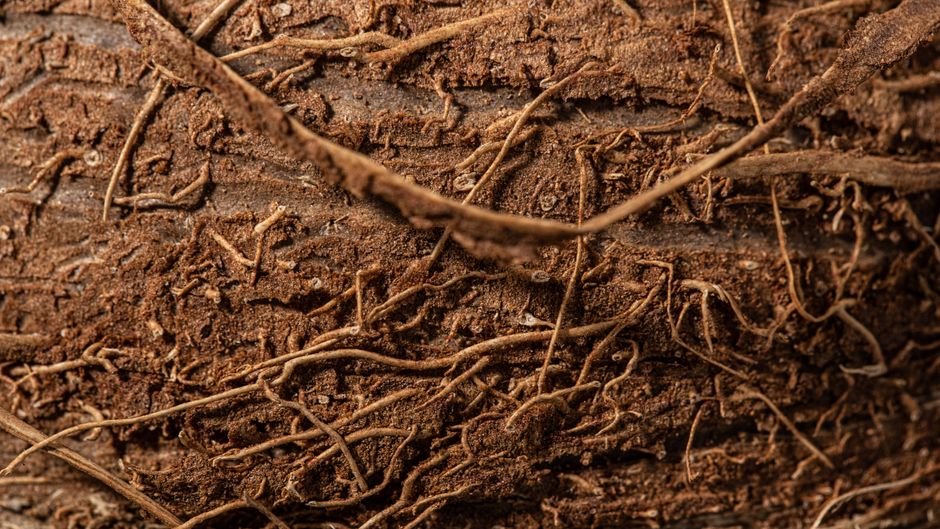
The process of how tree roots damage sewer lines in the Pacific Northwest is often a slow-motion disaster. It doesn’t happen overnight, but once it starts, it is relentless. It begins when a tree’s “scout” roots—hair-like fibers—detect the warmth and moisture of a sewer lateral.
Because sewer pipes carry warm water (from your showers, dishwashers, and laundry), they create a temperature differential with the cool PNW soil. This causes condensation to form on the outside of the pipe. If the pipe has a tiny crack or a loose seal at a joint, water vapor escapes into the surrounding soil.
The roots follow this vapor trail to the source. A root tip as thin as a piece of thread can enter a fissure as small as 1/8 inch. Once inside, the root has found paradise: a constant flow of water and “food” in the form of organic waste.
As the root drinks, it expands. A single hair-like fiber can grow into a woody, thick cable that eventually fills the entire diameter of the pipe. This causes:
- Snagging: Toilet paper and solid waste get caught on the root mass, leading to frequent backups.
- Joint Separation: As the roots thicken, they act like a wedge, physically forcing pipe sections apart.
- Pipe Collapse: Eventually, the structural integrity of the pipe is compromised, leading to a total collapse that requires excavation.
For a deeper look at this process specifically in our region, check out our guide on Can Tree Roots Grow Into Your Drain Lines in the Pacific Northwest.
Vulnerable Pipe Materials in Older PNW Homes
If your home in Bremerton or Port Orchard was built before 1980, the material of your sewer line plays a huge role in your risk level. Modern PVC pipes use solvent-welded joints that are almost entirely root-proof, but older materials are much more susceptible:
- Vitrified Clay: Common in homes built before 1970. These were installed in short sections, meaning there is a joint every few feet. Over time, the mortar in these joints cracks, providing easy entry points for roots.
- Orangeburg Pipe: Used from the 1940s through the 1970s, this is essentially layers of wood pulp sealed with coal tar. It is notoriously weak and can be easily crushed or penetrated by aggressive root systems.
- Concrete: Over time, the acidic gases in sewer lines can cause “microbial-induced corrosion,” thinning the walls of concrete pipes until roots can push right through.
- Cast Iron: While strong, cast iron eventually rusts and develops “scale.” This rough surface can trap debris, and small rust holes can invite root intrusion.
Understanding your pipe material is essential for long-term planning. You can find more details on these material risks at Tree Roots and Old Pipes: Warning Signs of a Sewer Line Blockage – Robinson Restoration.
High-Risk Tree Species and How Tree Roots Damage Sewer Lines in the Pacific Northwest
Not all trees are created equal when it comes to plumbing safety. Some species in the Pacific Northwest are “water-seekers” with aggressive, fast-growing root systems that can extend two to three times the height of the tree.
- Willow: Perhaps the most dangerous tree to plant near a sewer line. Willows have an incredible thirst and will find even the smallest leak.
- Poplar and Cottonwood: These trees grow very fast and have shallow, wide-reaching root systems that are highly invasive.
- Maples (Silver and Bigleaf): While iconic to the PNW, Silver Maples are known for having “thirsty” roots that frequently target old clay pipes.
- Birch: These trees have extensive root systems that can travel surprisingly long distances to find moisture.
Early Warning Signs of Root Intrusion in Your Yard
Because your sewer line is buried several feet underground, you won’t see the damage directly. Instead, you have to look for the “symptoms” of how tree roots damage sewer lines in the Pacific Northwest.
- The “Gurgle” Effect: If you hear a gurgling sound coming from your toilet when you run the bathroom sink, it’s a sign that air is trapped in the line by a partial blockage—often a root mass.
- Simultaneous Slow Drains: If just one sink is slow, it’s a local clog. If the kitchen, bath, and laundry are all draining slowly at the same time, the problem is in the main sewer lateral.
- The Fertilizer Effect: Have you noticed a patch of grass in your yard that is significantly greener and grows faster than the rest? This is often a sign of a leaking sewer pipe that is essentially “fertilizing” the lawn from below.
- Sewage Odors: A persistent smell of rotten eggs in your yard or basement is a clear indicator that the line is breached.
- Sinkholes or Depressions: If roots have caused a significant break, sewage can wash away the soil surrounding the pipe, leading to a small sinkhole in your lawn.
Ignoring these signs can lead to a messy backup in your home. We discuss the risks of waiting in our article: How Long Can You Wait to Fix a Slow Drain Before It Becomes a Bigger Problem.
Professional Methods for Removing Roots and Repairing Pipes
When roots have taken hold, DIY chemicals like “root killer” often fail because they only kill the roots they touch, leaving the woody mass inside the pipe and the structural crack wide open. Professional intervention is required to actually clear the line and prevent immediate regrowth.
- Sewer Camera Inspection: This is the most important step. We use high-definition, waterproof cameras to see exactly where the roots are, how thick they are, and whether the pipe is still structurally sound. This “scoping” acts as insurance against unnecessary digging.
- Mechanical Cutting: For thick, woody roots, a specialized auger with a rotating blade can be used to cut the roots out of the line, restoring flow.
- Hydro Jetting: This is often the preferred method. It uses high-pressure water (up to 4,000 PSI) to blast away root masses and clear out grease or scale. It’s more effective than a snake because it cleans the entire circumference of the pipe.
To understand which method is right for your situation, read our comparison: Hydro Jetting vs Drain Snake Which Is Better for Stubborn Clogs.
Trenchless Technology and How Tree Roots Damage Sewer Lines in the Pacific Northwest
In the past, repairing a root-damaged pipe meant digging a massive trench through your driveway or garden. Today, we utilize trenchless technology to fix the problem with minimal disruption to your Port Ludlow or Silverdale home.
- Epoxy Lining (Cured-in-Place Pipe): We can insert a flexible liner coated in epoxy resin into your existing pipe. Once it hardens, it creates a “pipe within a pipe” that is seamless and has no joints for roots to enter.
- Pipe Bursting: This involves pulling a new HDPE (High-Density Polyethylene) pipe through the old one. The old pipe is shattered (burst) outward, and the new, root-resistant pipe takes its place.
These methods are particularly valuable in the PNW because they allow us to save mature trees and expensive landscaping while providing a permanent fix.
Long-Term Prevention: Landscaping and Maintenance Strategies
Prevention is always more cost-effective than repair. If you are landscaping a new home in Belfair or Kingston, or replacing a tree in an older neighborhood, follow these guidelines:
- Install Root Barriers: These are vertical sheets of plastic or metal buried 30 to 48 inches deep between your trees and your sewer line. They redirect root growth downward and away from your pipes.
- Strategic Planting: Know where your sewer line is! You can often find this information through your local municipality or by having a professional locate the line for you.
- Safe Distance: As a rule of thumb, plant small trees at least 10 feet away and large trees at least 20 feet away from your sewer lateral.
Sewer-Safe vs. Aggressive PNW Species
| Plant These (Sewer-Safe) | Avoid These (Aggressive) |
|---|---|
| Japanese Maple | Willow |
| Dogwood | Silver Maple |
| Serviceberry | Black Cottonwood |
| Crape Myrtle | Poplar |
| Eastern Redbud | American Elm |
Regular maintenance is also key. For more tips on keeping your system running smoothly, see How Often Should You Have Drains Professionally Cleaned in Washington State.
Maintenance Schedules and How Tree Roots Damage Sewer Lines in the Pacific Northwest
If you have mature trees on your property, a “set it and forget it” attitude can be dangerous. We recommend:
- Sewer Scoping Every 2 Years: For homes with older pipes and large trees, a quick camera inspection every two years can catch root “hair” before it becomes a massive blockage. Studies show this reduces emergency incidents by 80%.
- Annual Foaming Treatments: Professional-grade foaming root killers can be applied once a year. The foam fills the entire pipe, killing roots at the top and sides, not just the bottom.
- Mind Your Drains: Avoid adding stress to a partially blocked line. Learn more about What Not to Put Down Your Drains to Avoid Costly Clogs.
Frequently Asked Questions about PNW Sewer Roots
Does homeowners insurance cover tree root damage to sewer lines?
In most cases, standard homeowners insurance policies do not cover damage caused by tree roots or gradual pipe deterioration. They typically only cover “sudden and accidental” events. However, many providers offer a “Service Line Coverage” or “Water Backup” rider for an additional fee. We highly recommend checking your policy and adding this coverage if you live in a neighborhood with mature trees.
How far should I plant a new tree from my sewer lateral?
The safe distance depends on the tree’s mature size. For small ornamental trees (under 20 feet tall), a 10-foot buffer is usually sufficient. For larger canopy trees, you should aim for 20 to 30 feet. Always use the tree’s mature height as a guide for how far its roots might eventually travel.
Can roots grow back after a professional hydro jetting service?
Yes. Hydro jetting is an excellent way to clear a blockage, but it does not fix the hole in the pipe that let the roots in. Unless the pipe is structurally repaired with a liner or replaced, the roots will eventually follow the same vapor trail back into the pipe. Think of hydro jetting as a “deep clean” and trenchless repair as the “permanent cure.”
Conclusion
At Eagle Pipe Mechanical, we understand that your home is your most significant investment. Dealing with the complexities of how tree roots damage sewer lines in the Pacific Northwest requires a team that knows the local landscape and the unique challenges of Kitsap and Jefferson County infrastructure.
As a 100% women-owned and operated business with over 45 years of experience, we pride ourselves on providing honest, efficient, and personable solutions. Whether you are in Suquamish, Hansville, or Gig Harbor, we are here to help you protect your home from underground damage.
We don’t offer 24/7 emergency services, which is why we emphasize the importance of our Eagle’s Nest maintenance plan. With regular 37-point inspections and priority status, we help you catch plumbing and HVAC issues before they become disasters.
Don’t wait for a backup to find out what’s happening under your lawn. Contact us today for more info about our plumbing services and let our experts give you the peace of mind you deserve.
Keep reading
Related articles.
Ready when you are
Need a tech who answers back?
Same-week scheduling across Kitsap and Jefferson County. Honest quotes, no pressure.