Heat Domes 101: PNW Cooling Needs Shift

How PNW Heat Domes Changed the Need for Home Cooling — And What It Means for Your Home
How PNW heat domes changed the need for home cooling is one of the most important questions facing homeowners in Kitsap and Jefferson Counties right now. Here's the short answer:
The 2021 Pacific Northwest heat dome was a turning point. Temperatures shattered records, and the region's housing stock — built for mild, rainy weather — was caught completely unprepared. At the time, only about 53% of Washington homes had any form of air conditioning. The result was devastating: over 250 deaths in the U.S. and more than 400 in Canada, with heat-related hospital visits running 69 times higher than the same period two years prior. Washington alone recorded approximately 159 excess deaths, making it the deadliest weather event in state history.
What changed after 2021:
- Cooling went from a luxury to a necessity across the Pacific Northwest
- Heat pumps surged in popularity as a dual heating-and-cooling solution suited to the PNW's mild, damp climate
- Policy conversations accelerated around tenant rights, building codes, and equitable access to cooling
- Climate projections sharpened the urgency — Washington averaged 3 extreme heat days per year between 1971 and 2021; by the 2050s, models project 17 to 30 per year
- Homeowners began evaluating their HVAC systems not just for winter warmth, but for summer survival
This guide walks Kitsap and Jefferson County homeowners through what heat domes are, why PNW homes are especially vulnerable, and how modern cooling solutions — especially heat pumps — can protect your household as extreme heat events become more frequent.
What is a Heat Dome and How Does It Form?
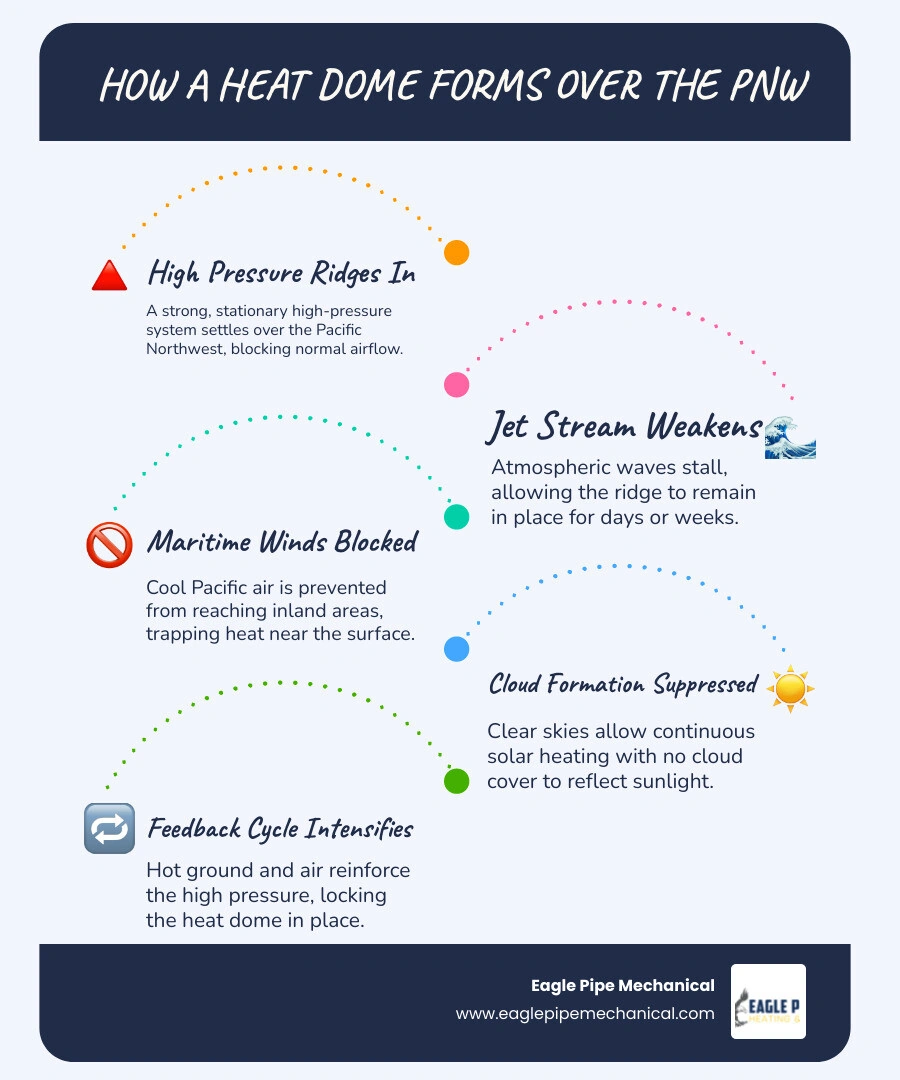
To understand why our summers have suddenly felt so intense, we have to look to the upper atmosphere. A "heat dome" is not actually a standard, formal scientific term, but rather a vivid description of a highly destructive meteorological event. It occurs when a persistent, strong high-pressure atmospheric system stalls over a region.
Normally, the jet stream acts as an atmospheric conveyor belt, keeping weather systems moving from west to east. However, when the jet stream weakens and develops deep, stagnant waves, a high-pressure system can park itself over a specific area. In the case of the Pacific Northwest, this massive ridge of high pressure blocks cooling maritime winds from the Pacific Ocean and prevents cloud formation.
Without clouds, the sun beats down relentlessly on the earth. As the ground warms, it dries out. This triggers a self-reinforcing feedback cycle: dry soil cannot facilitate evaporative cooling, which causes surface temperatures to climb even higher. The high-pressure system aloft then acts like a giant lid on a boiling pot, compressing the rising warm air back down toward the surface. As this air sinks, it compresses and warms even further, trapping intense heat near the ground for days or even weeks.
This atmospheric feedback loop is exactly what drove the unprecedented temperatures during the June 2021 event. For a detailed breakdown of the atmospheric forces at play, you can read the Scientific analysis of the 2021 Northwest Heat Dome.
How PNW Heat Domes Changed the Need for Home Cooling
Historically, air conditioning was considered an afterthought in Western Washington. Our mild summers, cooled by the marine layers of the Puget Sound, meant that a couple of box fans and open windows at night were all it took to stay comfortable. The 2021 heat dome permanently shattered that assumption.
The sheer scale of the 2021 event exposed how deeply unprepared our region was. Across Washington, Oregon, and British Columbia, nearly 800 people lost their lives due to heat-related causes. The health impacts were swift and severe, with emergency rooms completely overwhelmed by patients suffering from heat exhaustion and heat stroke. To understand the systemic challenges our health sector faced during this crisis, you can explore the Lessons from the 2021 Pacific Northwest heat dome.
As we look at the climate landscape in June 2026, the data shows that a heat dome of the 2021 magnitude is roughly 150 times more likely to occur today than in the pre-industrial era. With global temperatures continuing to rise, scientists warn that if global warming reaches 2°C, an event of this severity could occur every 5 to 15 years. This reality has completely reframed how pnw heat domes changed the need for home cooling — shifting air conditioning from a comfort-based upgrade to an essential piece of life-saving home infrastructure.
The Vulnerability of Historically Uncooled PNW Homes
Why did the heat dome prove so dangerous to residents inside their own homes? The answer lies in how our homes were built. For decades, Pacific Northwest residential architecture was optimized for heat retention. Thick insulation, double-paned windows positioned to capture sunlight, and a lack of active ventilation systems were designed to keep homes warm and cozy during our long, damp winters.
When extreme heat hits, these homes act like greenhouses. They absorb solar radiation during the day and lock that heat inside. Without active cooling, indoor temperatures can quickly exceed outdoor temperatures, especially on upper floors. Simply opening windows can backfire, as the outdoor air during a heat dome is often dry and scorching, and overnight temperatures during these events rarely drop low enough to provide passive relief.
This risk is amplified by "urban heat islands," where asphalt, concrete, and roofing materials absorb and radiate heat, keeping neighborhoods significantly warmer than surrounding rural areas. Furthermore, there is a stark equity gap in cooling access. In the Seattle-Tacoma-Bremerton region, higher-income households are significantly more likely to have air conditioning than lower-income households. If you are preparing your property for the summer months, taking proactive steps is crucial; learn more about preparing your cooling system for warmer weather to avoid being caught off guard.
How PNW Heat Domes Changed the Need for Home Cooling for Renters
The shift in cooling needs has sparked a massive legal and social conversation regarding tenant protections. Because air conditioning was historically viewed as a luxury, landlord-tenant laws in Washington did not classify cooling as a basic habitability requirement like heating.
During the 2021 heat dome, the vast majority of those who died indoors were renters living in multifamily housing complexes without air conditioning. In the years since, tenant advocates have pushed hard for "right-to-cooling" legislation. These efforts have centered on three progressive policy stages:
- Permission: Ensuring landlords cannot arbitrarily ban tenants from installing safe window or portable AC units.
- Recognition: Identifying extreme heat as a public health crisis that requires municipal intervention.
- Performance Standards: Establishing maximum allowable indoor temperatures (such as 80°F) that landlords must legally maintain.
While statewide legislation continues to evolve, local municipalities have begun taking action. For instance, cities like Portland and Spokane have pioneered local ordinances to protect renters' rights to install cooling equipment. To understand the ongoing policy battles and legal hurdles surrounding this issue, read about Why renters struggle for cooling access.
Transitioning to Heat Pumps: The Modern PNW Solution
Now that active cooling is a necessity, how do we install it without causing our energy bills — and carbon footprints — to skyrocket? The answer is the modern heat pump.
Unlike traditional air conditioners that only cool, or gas furnaces that only heat, a heat pump is a dual-function system. It operates on a simple principle: transferring heat rather than creating it.
- In the summer: The system extracts heat from inside your home and pumps it outdoors, leaving your indoor air cool and dehumidified.
- In the winter: The process reverses. The system extracts ambient heat from the outdoor air (even when it feels cold outside) and transfers it indoors to warm your home.
Because heat pumps simply move heat, they are incredibly efficient. They can deliver up to three to four times more heat energy than the electrical energy they consume. This makes them the ultimate tool for both summer comfort and winter warmth. For practical tips on maximizing your system's summer performance, check out our guide on How to use your heat pump for summer cooling.
Moreover, transitioning away from fossil-fuel-based heating to electric heat pumps is a massive win for the environment. According to a Sightline Institute analysis on heat pumps, replacing gas furnaces with heat pumps across the region could avert millions of metric tons of carbon emissions annually, helping to tackle the root cause of the very heat domes we are trying to survive.
Ductless Mini-Splits for Homes Without Existing Ductwork
Many older homes in communities like Port Townsend, Bainbridge Island, and Poulsbo rely on electric baseboards, wall heaters, or radiant heating. These homes lack the ductwork required for a traditional central air conditioning system.
For these properties, ductless mini-split systems are an absolute game-changer. A ductless system consists of a quiet outdoor compressor connected to one or more indoor air-handling units mounted on the wall or ceiling.
Benefits of ductless mini-splits include:
- No ductwork required: They only require a small, three-inch hole through an exterior wall for the refrigerant lines.
- Zoned comfort: You can control the temperature of individual rooms independently, meaning you don't waste energy cooling empty guest rooms.
- Whisper-quiet operation: The noisy compressor sits outside, leaving your indoor living spaces peaceful.
If your home lacks built-in ducts, explore our comprehensive breakdown of ductless heating and cooling solutions and discover Why choose a ductless AC system to see how these systems can fit seamlessly into your space.
How PNW Heat Domes Changed the Need for Home Cooling and Year-Round Efficiency
Our local climate in Kitsap and Jefferson Counties is unique. We experience damp, mild winters, occasional freezing cold snaps, and increasingly hot, humid summers influenced by the Puget Sound.
Traditional single-stage air conditioners are designed to turn fully on or fully off. This can lead to rapid temperature swings and poor humidity control. Modern heat pumps, however, utilize variable-speed inverter technology. Instead of blasting air and shutting off, they run continuously at a low, highly efficient speed, matching the exact heating or cooling load of your home. This continuous operation is incredibly effective at pulling moisture out of the damp marine air, keeping your home comfortable without making it feel like a refrigerator.
For our coastal environment, finding the right balance is key. You can read more about selecting the Best HVAC setup for the Olympic and Kitsap Peninsula to match our unique weather patterns.
Below is a comparison of how different residential systems stack up:
| Feature | Modern Heat Pump | Traditional Air Conditioner | Gas/Propane Furnace |
|---|---|---|---|
| Cooling Capability | Yes (Highly Efficient) | Yes | No |
| Heating Capability | Yes (Highly Efficient) | No | Yes |
| Energy Efficiency | Up to 300%–400% | Standard AC Ratings | 80%–98% |
| Dehumidification | Excellent (Variable-speed) | Standard | Low (Dries air out in winter) |
| Carbon Footprint | Low (All-Electric) | Medium (Depends on heating source) | High (Fossil Fuel) |
2026 Financial Incentives and Rebates for PNW Homeowners
While the federal Section 25C tax credit for air-source heat pumps experienced a "credit cliff" on December 31, 2025, there are still excellent financial pathways available for homeowners upgrading their systems in 2026.
By utilizing state-level programs, utility rebates, and specialized financing, you can significantly lower your upfront investment:
- HEEHRA (High-Efficiency Electric Home Rebate Act): Low- and moderate-income families in Washington may qualify for substantial rebates covering up to 100% of heat pump installation costs.
- Utility Rebates: Local utilities serving Kitsap and Jefferson Counties offer instant discounts and rebates for homeowners transitioning from electric resistance heating (like baseboards) to high-efficiency heat pumps.
- Flexible Financing: At Eagle Pipe Mechanical, we offer convenient financing options through Synchrony, making it easier to fit a vital home comfort upgrade into your household budget.
To make sure your new system operates at peak efficiency from day one, take a look at our tips on enhancing your heat pump's cooling efficiency.
Frequently Asked Questions about PNW Home Cooling
Do I need a backup furnace for a heat pump in Washington?
For the vast majority of homes in Kitsap and Jefferson Counties, the answer is no. Modern cold-climate heat pumps are engineered to operate at 100% heating capacity even when outdoor temperatures drop to 5°F, and they continue to run efficiently well below that.
During our rare, extreme winter cold snaps, the system can utilize built-in electric resistance heat strips to provide a temporary boost. While some homeowners prefer a "dual-fuel" system (combining a heat pump with a gas furnace), a standalone heat pump is more than capable of handling our coastal winters while offering total energy independence from fossil fuels.
How does coastal salt air affect my air conditioning system?
If you live in Port Townsend, Bainbridge Island, Kingston, or Hansville, you know that coastal living comes with beautiful views — and corrosive salt air. Salt air is a silent killer for outdoor HVAC condensers. It accelerates the corrosion of aluminum fins and copper tubing, leading to refrigerant leaks, reduced efficiency, and premature system failure.
To protect your investment:
- Rinse the outdoor unit: Gently spray your outdoor unit with fresh water from a garden hose once a month to wash away salt deposits.
- Apply protective coatings: Professional technicians can apply specialized anti-corrosive coil coatings during installation or maintenance.
- Schedule regular service: Coastal systems require proactive care. Read about the Annual HVAC maintenance benefits and learn How proper HVAC maintenance prevents mold growth to keep your coastal system running smoothly.
What are the projected extreme heat days for Washington by the 2050s?
The trend is clear: our summers are getting hotter. Historically, Western Washington averaged only about three days per year where temperatures climbed above 90°F. However, climate models project that by the 2050s, Washingtonians will experience between 17 and 30 extreme heat days per year.
This dramatic shift means that heat waves are no longer rare anomalies we can simply wait out. They are a permanent fixture of our seasonal reality, requiring long-term home resilience planning. For more details on regional temperature projections, check out the Bellingham Herald report on rising temperatures.
Conclusion
The climate is changing, and our homes must change with it. The lessons of the 2021 heat dome have taught us that active, efficient home cooling is no longer a luxury — it is a foundational requirement for keeping our families safe and comfortable.
At Eagle Pipe Mechanical, we are proud to be a 100% women-owned and operated business with over 45 years of experience serving our neighbors across Kitsap and Jefferson Counties. From Poulsbo and Bainbridge Island to Port Townsend, Silverdale, and Bremerton, our team provides honest, knowledgeable, and highly efficient residential HVAC, plumbing, and gas piping solutions. We don't offer 24/7 emergency services, but we do offer comprehensive maintenance plans, personable solutions, and a deep commitment to helping our community optimize energy efficiency.
If you are ready to evaluate your home's cooling needs and find the perfect heat pump or ductless system for your space, we are here to help. Schedule professional air conditioning services with our trusted team today.
CUSTOMER TESTIMONIALS
Our customers’ experiences say more than we ever could. See how Eagle Pipe Heating & Air has earned trust across the Pacific Northwest with reliable service and lasting results.