What Does an HVAC Maintenance Visit Include?

What an HVAC Maintenance Visit Includes — and Why It Matters for Your Home
What does an HVAC maintenance visit include is one of the most practical questions a homeowner can ask before scheduling service. And if you just want the short answer, here it is:
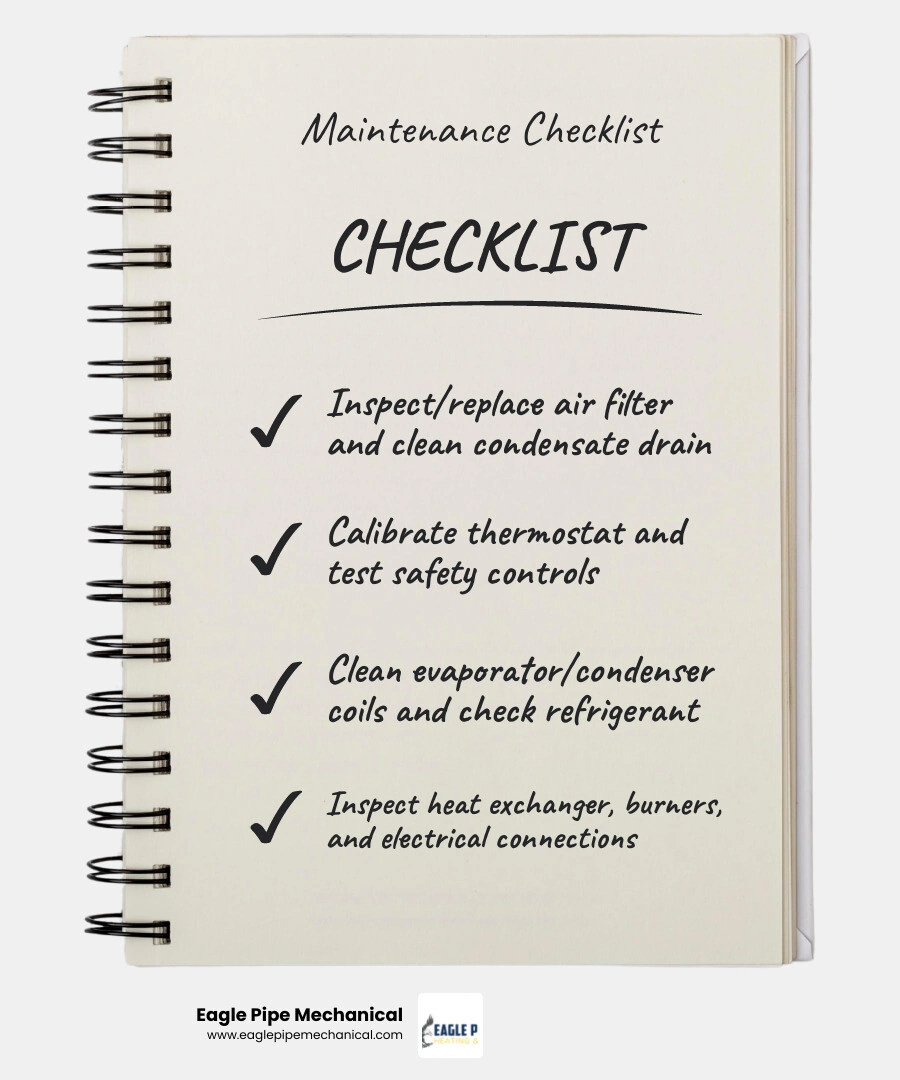
A professional HVAC maintenance visit typically covers:
- Air filter inspection and replacement
- Thermostat calibration and testing
- Electrical connection inspection and tightening
- Lubrication of moving parts
- Condensate drain line clearing
- Evaporator and condenser coil cleaning
- Refrigerant level check
- Blower motor inspection and cleaning
- Safety controls testing
- Heat exchanger inspection (heating season)
- Burner assembly and gas pressure check (heating season)
- Overall system performance verification
Most visits take between one and one and a half hours per system, and the industry standard is two visits per year — one in spring before cooling season and one in fall before heating season.
For homeowners in Kitsap and Jefferson County, where damp winters and warm summers put real strain on HVAC equipment, skipping that routine service can mean higher energy bills, surprise breakdowns, and voided manufacturer warranties. Your system quietly keeps your home comfortable every day — and regular maintenance is what keeps it capable of doing that for 15 to 20 years.
Know your what does an hvac maintenance visit include terms:
Why Regular Heating and Cooling Tune-Ups Matter
Many homeowners view heating and cooling maintenance as an optional luxury. In reality, skipping these essential tune-ups sets off a "spiral of inefficiency" that slowly damages your system and drains your wallet.
When you invest in routine care, you reap immediate and long-term rewards across several key areas:
- Lower Utility Bills: Dirt is the natural enemy of your heating and cooling equipment. When dust blankets your coils or clogs your air filters, your system has to work twice as hard to move air and exchange heat. A dirty filter alone can significantly restrict airflow, forcing your blower motor to consume up to 15% more energy. Over time, neglected coils can lower overall system efficiency by 10% to 30%, resulting in spiked utility bills.
- Extended System Lifespan: A well-maintained HVAC system can reliably last 15 to 20 years, whereas a neglected unit often fails prematurely around the 10-year mark. Routine preventative care can improve your system's overall lifespan by up to 48%. Think of it like a car: skipping oil changes won't break your vehicle tomorrow, but it guarantees engine failure years before its time.
- Improved Indoor Air Quality (IAQ): Your HVAC system acts as the lungs of your home. If the internal components are coated in dust, pet dander, and biological growth, those pollutants are continuously re-circulated throughout your living spaces. In fact, indoor pollutant levels are often two to five times higher than outdoor levels, according to the U.S. Environmental Protection Agency (EPA). Regular maintenance removes these accumulations, keeping your family breathing clean, healthy air.
- Warranty Compliance: If your system is relatively new, it likely came with a 5-year or 10-year manufacturer's parts warranty. However, almost all major manufacturers explicitly state in their terms that the warranty is only valid if the system receives annual professional maintenance. If a major component like your compressor fails and you cannot provide documented service reports, your claim may be denied.
To learn more about the financial and practical benefits of proactive care, check out our guides on Annual HVAC Maintenance - Is It Worth It? and HVAC Preventive Maintenance.
What Does an HVAC Maintenance Visit Include for Homeowners?
When a certified technician arrives at your home for a professional tune-up, they shouldn't just swap your air filter, glance at your thermostat, and leave. A thorough maintenance visit is a highly technical process involving specialized diagnostics, safety tests, and deep physical cleaning.
Here is what our comprehensive, professional check-up covers to protect your home:
- Thermostat Calibration: We verify that your thermostat is reading the indoor temperature accurately and communicating correctly with your heating and cooling equipment. This ensures you aren't wasting energy on over-cooling or over-heating due to a faulty sensor.
- Electrical Connections and Safety Checks: Loose electrical connections can cause voltage drops, component damage, or even electrical fires. Technicians measure voltage and amperage across motors, test the starting capacitors (the single most common failure point in AC units), and tighten all wire terminals.
- Condensate Drain Line Maintenance: As your air conditioner or heat pump cools your home, it extracts moisture from the air. This water drains out through a small plastic line. If dust, algae, or debris clogs this line, water will back up into your home, causing catastrophic water damage to your ceilings, walls, or floors. Technicians physically clear and flush these lines to ensure smooth drainage.
- Blower Motor and Fan Assembly Inspection: The blower motor is responsible for pushing conditioned air through your ductwork. We inspect the blower wheel, clean off any accumulated dust that could unbalance the blades, and lubricate motor bearings to eliminate friction.
- Static Pressure Measurements: Think of this as a "blood pressure test" for your ductwork. Measuring static pressure tells us if there are major air blockages or duct leaks that are preventing proper airflow throughout your home.
If you live in Poulsbo, Kingston, or Bainbridge Island, you can secure this detailed level of care by scheduling our specialized HVAC Maintenance Poulsbo WA service.
What Does an HVAC Maintenance Visit Include for Cooling Systems?
During the spring cooling visit, the focus shifts heavily toward heat transfer and moisture management.
- Evaporator and Condenser Coil Cleaning: Your outdoor condenser coil and indoor evaporator coil must be completely clean to release and absorb heat. Even a thin layer of dirt acts as an insulator, reducing your system's cooling capacity and forcing it to run longer cycles. We carefully brush and wash these coils using manufacturer-approved, low-pressure methods.
- Refrigerant Level and Leak Check: Refrigerant is the chemical lifeblood that carries heat out of your home. If your refrigerant level is off by even a small amount, your system's efficiency can drop by 15% or more, and your compressor may overheat and fail. Technicians perform precise superheat and subcooling calculations to ensure your charge is perfect. If a leak is detected, we locate and repair it rather than simply "topping off" the system, which violates environmental safety guidelines and ignores the root problem.
To prepare your cooling system for the upcoming summer heat waves, read our guide on Spring HVAC System Safety Checks.
What Does an HVAC Maintenance Visit Include for Heating Systems?
As the damp Pacific Northwest autumn rolls in, our fall maintenance visits pivot to focus on heating reliability and, most importantly, household safety.
- Heat Exchanger Inspection: In a gas furnace, the heat exchanger is the metal chamber where fuel is burned to create warmth. If this metal cracks due to years of expanding and contracting, deadly carbon monoxide (CO) gas can leak directly into your home's air stream. Technicians use specialized cameras to perform rigorous visual and electronic tests on the heat exchanger.
- Burner Assembly and Gas Pressure Calibration: We clean the burner ports to ensure clean, blue, efficient combustion. We also test and adjust the gas pressure to match the manufacturer's exact specifications, preventing fuel waste and soot build-up.
- Flue and Venting Inspection: We inspect the exhaust flue to ensure that combustion byproducts are venting safely out of your roof or wall without any blockages, leaks, or backdrafting issues.
For a deeper look into keeping your heating system safe and efficient, explore our article on How to Maintain Your Heating and Cooling System.
How Often Should You Schedule Professional HVAC Maintenance?
The industry standard recommendation is to have your comfort systems serviced twice per year: once in the spring to prepare your cooling system for summer, and once in the fall to prepare your heating system for winter.
If you have a traditional split system (a gas furnace paired with an outdoor air conditioner), this schedule is straightforward. The furnace is serviced in the fall, and the AC is serviced in the spring.
However, many homes in Kitsap and Jefferson Counties rely on heat pumps or ductless mini-split systems for year-round comfort. Because a heat pump works double duty—cooling your home in July and heating it in January—it undergoes twice the wear and tear of a single-season system. For these year-round systems, bi-annual professional service is absolutely essential to prevent mid-season breakdowns.
To understand the best timing for your specific home setup, check out our comprehensive resources: How Often Should You Service Your HVAC System and How Often HVAC Service Complete Guide.
DIY Maintenance vs. Tasks That Require a Certified Professional
While professional maintenance is irreplaceable, homeowners can take several simple steps between service visits to keep their systems running smoothly. However, it is crucial to know where your DIY boundaries lie. Attempting complex electrical, gas, or chemical work without proper training and tools is incredibly dangerous and will void your equipment warranties.
| Maintenance Task | DIY Friendly? | Why It's Best Left to a Professional |
|---|---|---|
| Changing Air Filters | Yes | Homeowners should check filters monthly and replace standard 1-inch filters every 1 to 3 months. |
| Clearing Outdoor Debris | Yes | Keep plants, shrubs, and leaves trimmed back to maintain a 2-foot clearance around your outdoor unit. |
| Cleaning Supply & Return Vents | Yes | Vacuum dust and pet hair off your register grilles to keep airflow pathways clear. |
| Refrigerant Handling | No | Requires EPA Section 608 certification under federal law. Handling refrigerant without a license is illegal and highly dangerous. |
| Electrical Diagnostics | No | High-voltage capacitors and wiring present severe shock hazards. Technicians use specialized meters to test components safely. |
| Heat Exchanger Inspections | No | Detecting microscopic cracks that leak carbon monoxide requires specialized diagnostic cameras and combustion analyzers. |
| Deep Coil Cleaning | No | Evaporator coils are delicate and easily damaged. Cleaning them requires professional-grade chemical washes and fin-straightening tools. |
Regularly swapping your air filters is the single most important task you can perform yourself. To learn how to select the right filter and replacement schedule for your home, read about the Regular Air Filter Replacement Importance.
When you are ready to hand the complex, high-voltage, and mechanical tasks over to certified experts, you can Schedule Professional HVAC Services with our team.
Frequently Asked Questions about HVAC Maintenance
What are the warning signs that my system needs immediate service?
You shouldn't wait for your seasonal maintenance visit if your system is showing any of these red flags:
- Strange Noises: Squealing, grinding, rattling, or loud banging sounds indicate failing bearings, loose belts, or broken components.
- Uneven Temperatures: If some rooms are freezing while others are stifling, your system is struggling with airflow or thermodynamic balance.
- Short Cycling: If your furnace or AC constantly turns on and off in rapid succession without ever reaching your thermostat's set temperature, it is overheating or experiencing control issues.
- Sudden Utility Spikes: An unexplained jump in your energy bills is a classic sign of a system running at a fraction of its normal efficiency.
Please note: While we do not offer 24/7 emergency services, we recommend scheduling a prompt service appointment during our normal business hours if you notice any of these warning signs.
What documentation should I receive after a maintenance visit?
After a high-quality maintenance visit, your technician should provide a detailed, written service report. This document is your proof of service for manufacturer warranty claims. It should include:
- A completed checklist of all inspected components.
- Exact performance metrics, such as voltage readings, capacitor microfarad values, static pressure, and refrigerant subcooling/superheat calculations.
- Notes on any minor parts replaced (like a worn capacitor or a fresh air filter).
- Honest, professional recommendations for any future repairs or upgrades your system may need.
How long does a typical professional maintenance visit take?
For a single, standard residential system, a thorough maintenance visit should take between 60 and 90 minutes. If a technician claims they are finished in under 20 minutes, they likely only performed a brief visual inspection rather than a true physical cleaning and electrical diagnostic.
If your home has multiple systems (such as an upstairs and downstairs split unit), expect the visit to take approximately two to three hours for a single technician to complete the work properly.
Conclusion
Understanding what does an hvac maintenance visit include empowers you to make smart decisions for your home's comfort, safety, and energy efficiency. By keeping up with bi-annual tune-ups, you protect your wallet from emergency repairs, lower your monthly energy consumption, and ensure your system lives out its full 15-to-20-year lifespan.
At Eagle Pipe Mechanical, we are proud to be a 100% women-owned and operated business with over 45 years of experience serving our neighbors across Kitsap and Jefferson Counties. From Poulsbo and Bainbridge Island to Port Ludlow, Silverdale, and Bremerton, our certified team is dedicated to providing honest, highly efficient, and personable comfort solutions.
To make seasonal upkeep entirely worry-free, we invite you to join our Eagle's Nest Maintenance Plan. Our members enjoy:
- Comprehensive 37-point system inspections twice per year.
- Extended parts and labor warranties.
- Priority customer status for scheduling.
- Valuable discounts on necessary repairs.
- Flexible financing options through Synchrony to keep your home comfort accessible.
Don't wait for the extreme weather of summer or winter to find out if your system is up to the task. Explore our Maintenance Plan details, learn more about our local HVAC Maintenance Poulsbo WA services, or Schedule Professional HVAC Services with our friendly team today!
CUSTOMER TESTIMONIALS
Our customers’ experiences say more than we ever could. See how Eagle Pipe Heating & Air has earned trust across the Pacific Northwest with reliable service and lasting results.