The Homeowner's Guide to Mini Split Benefits and Basics

Ductless Mini Split Systems Explained: What Every Homeowner Should Know
Ductless mini split systems explained simply: they are heating and cooling systems made up of a small outdoor compressor unit and one or more indoor air handlers, connected by a narrow conduit running through a small hole in the wall — no ductwork required.
Here is a quick overview of the basics:
- What they do: Heat and cool individual rooms or zones independently
- Main components: Outdoor compressor/condenser + indoor air handler(s) + refrigerant conduit
- How they install: A roughly 3-inch hole through the wall connects the two units
- Efficiency advantage: No ducts means no duct energy losses, which can exceed 30% in traditional systems
- Dual function: Most models work as heat pumps, providing both heating and cooling
- Lifespan: Expect 10 to 15 years of reliable use with proper maintenance
- Zoning: Multi-zone systems can connect up to 8 indoor units to a single outdoor unit
If you own a home in Kitsap or Jefferson County, Washington, chances are you have come across the term "mini split" more than once. Older homes in the Pacific Northwest were often built without central ductwork, and newer homeowners adding a sunroom, garage workspace, or finished basement quickly discover that extending existing ducts is not always practical. Ductless mini splits solve that problem directly — and they do it while using less energy than most traditional forced-air systems.
This guide walks you through everything you need to know: how these systems work, their real advantages and limitations, how to size and install them correctly, and how to keep them running efficiently for years to come.
What is a Ductless Mini Split System?
At its core, a ductless mini split is a "split" system because it separates the noisy parts of an air conditioner or heat pump from the quiet parts. In a traditional central system, you have a massive unit outside and a large furnace or air handler inside, connected by a web of bulky metal ducts. A ductless system eliminates that middleman.
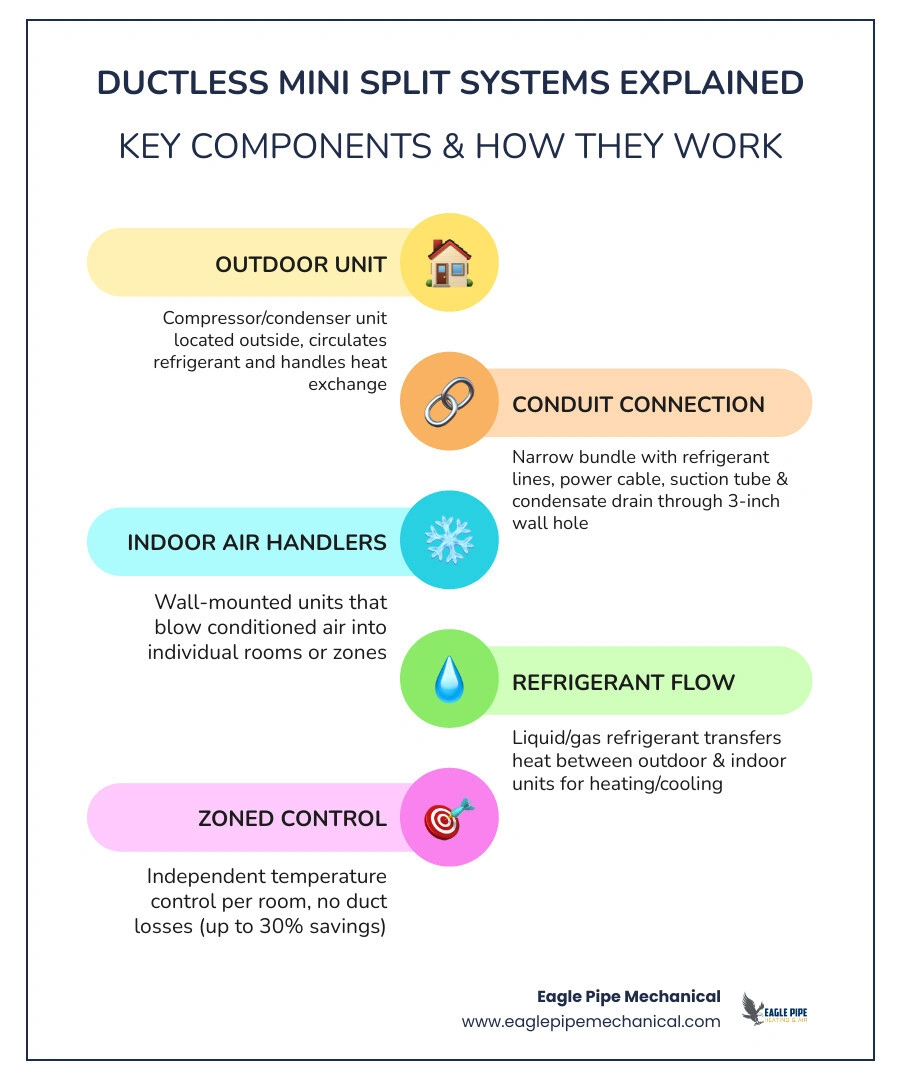
The system consists of two primary parts: an outdoor compressor/condenser and one or more indoor air-handling units. These are linked by a "conduit," which is a bundle containing the power cable, refrigerant tubing, suction tubing, and a condensate drain.
Because they don't rely on ducts, these systems are incredibly flexible. You can read more about how we use Ductless Mini Split Systems For Comfort to solve temperature issues in specific rooms. According to the Department of Energy, these systems are particularly useful for residential retrofits and room additions where extending ductwork is not feasible.
How Ductless Mini Split Systems Work Explained
To have ductless mini split systems explained fully, we have to look at the science of heat transfer. These systems don't actually "create" cold air; they move heat from one place to another.
Cooling Mode
In the summer, the indoor unit uses a fan to pull warm air from your room over evaporator coils filled with cold refrigerant. The refrigerant absorbs the heat and carries it through the conduit to the outdoor unit. The outdoor compressor then releases that heat into the outside air.
Heating Mode
Because most mini splits are heat pumps, they can run in reverse. Even in a crisp Port Ludlow winter, there is thermal energy in the outdoor air. The system extracts that heat and pumps it indoors. Modern units are incredibly resilient; some select systems can still provide 80% of their heating capacity even when it is -22°F outside. We’ve seen how Ductless Mini Splits Boost Efficiency by using this heat pump technology rather than burning fossil fuels.
Inverter Technology
One of the "secret ingredients" to their efficiency is inverter technology. Think of a traditional HVAC system like a light switch—it’s either 100% on or 100% off. This leads to temperature swings and high energy spikes. An inverter-driven compressor works more like a dimmer switch or cruise control. It slows down or speeds up to maintain a perfectly steady temperature, which saves a massive amount of electricity. You can learn more about the technical side of these Ductless Minisplit Heat Pumps from the Department of Energy.
Key Advantages of Going Ductless in Washington
Living in places like Bainbridge Island or Port Townsend presents unique HVAC challenges. Our maritime climate is damp, and our homes range from historic Victorians to modern eco-friendly builds. Here is why ductless makes sense for us:
- Energy Savings: Duct losses can account for more than 30% of energy consumption for air conditioning. By removing the ducts, you keep all that conditioned air where it belongs—in your living room.
- Zoned Control: Why pay to heat the guest room in Suquamish if no one is using it? You can adjust the temperature for each room individually.
- Quiet Operation: Some outdoor units operate as quietly as 46 decibels—about the level of a quiet conversation. The indoor units are even quieter, often just a whisper-soft hum.
- Easy Installation: We don't have to tear apart your ceilings or walls. A small three-inch hole is all that's required to connect the units.
| Feature | Ductless Mini Split | Traditional Central HVAC |
|---|---|---|
| Ductwork Required | No | Yes |
| Energy Loss | Minimal | Up to 30%+ via ducts |
| Zoning | Built-in (per unit) | Requires expensive dampers |
| Installation Time | Often 1 day | Multiple days/weeks |
| Noise Level | Very Quiet | Moderate to Loud |
We frequently discuss these Ductless Mini Split Systems Advantages with homeowners looking to modernize their comfort. For those specifically looking for cooling, the Ductless Ac System Installation Benefits are even more pronounced during our increasingly warm Washington summers.
Efficiency of Ductless Mini Split Systems Explained
Efficiency is measured by SEER2 (Seasonal Energy Efficiency Ratio) for cooling and HSPF2 (Heating Seasonal Performance Factor) for heating. While traditional ducted heat pumps usually top out around 25 SEER2, ductless systems can achieve ratings as high as 35 SEER2. If you are looking for a Ductless Mini Split in Poulsbo, WA, these ratings mean significantly lower monthly utility bills compared to baseboard heaters or old furnaces.
Versatile Indoor Units for Ductless Mini Split Systems Explained
You aren't stuck with just one "look." Depending on your home's layout in Silverdale or Kingston, you can choose from several styles:
- Wall-Mounted: The most common type, usually placed high on a wall to stay out of the way.
- Floor-Mounted: Great for rooms with low ceilings or where you’d prefer the unit to look like a traditional radiator.
- Ceiling Cassettes: These sit flush with your ceiling, making them nearly invisible.
Whether you need a Ductless Mini Split in Silverdale, WA or a custom solution elsewhere in Kitsap County, there is a head style that fits your aesthetic.
Installation, Sizing, and Maintenance
Getting the right fit is the most important part of having ductless mini split systems explained. If a unit is too small, it will run constantly and never get the room comfortable. If it’s too large, it will "short cycle," turning on and off so fast that it fails to dehumidify the air, leading to a clammy feeling.
Sizing by the Numbers
We use BTU (British Thermal Units) to measure capacity. As a general rule of thumb:
- 12,000 BTU: Good for 400 to 650 square feet.
- 18,000 BTU: Good for 600 to 1,000 square feet.
- 24,000 BTU: Good for 800 to 1,300 square feet.
Single-Zone vs. Multi-Zone
A single-zone system is one indoor unit connected to one outdoor unit—perfect for a garage or a master suite. A multi-zone system allows one outdoor unit to power multiple indoor units. Some advanced systems can support up to 8 indoor units from a single outdoor compressor, allowing you to climate-control your entire home. For residents in Port Orchard, our Ductless Installation Port Orchard services cover both simple and complex multi-zone setups.
Keeping it Running
Maintenance is surprisingly simple but absolutely necessary.
- Clean the Filters: You should check your indoor unit filters every month. If they are clogged with dust or pet hair, the system has to work twice as hard.
- Clear the Outdoor Unit: Make sure leaves, snow, or debris aren't blocking the airflow of the outdoor unit.
- Professional Tune-ups: Once a year, have a professional check the refrigerant levels and clean the coils.
With proper care, you can expect 10 to 15 years of life from your system. If things do go wrong, we have a guide on Troubleshooting Ductless Mini Splits to help you identify the issue quickly.
Frequently Asked Questions
Do mini splits work in extreme cold?
Yes! While older heat pumps used to struggle when the temperature dropped, modern ductless technology is built for the Washington climate. Select systems can provide 100% heating capacity down to 5°F and continue operating effectively even at -22°F. This makes a Ductless Mini Split in Port Townsend, WA a very reliable primary heat source.
How many indoor units can I have?
It depends on the outdoor unit's capacity. Most residential multi-zone systems support between two and five indoor units, but some heavy-duty models can support up to 8. This allows you to create a custom comfort plan for every bedroom, the kitchen, and the living room. If you're looking for a Ductless Mini Split in Bremerton, WA, we can help you design a multi-zone layout that fits your home's footprint.
Are they quieter than central air?
Absolutely. Because the compressor is located outside and the indoor units use high-tech fans, they are "whisper-quiet." Most indoor units are about seven inches deep and blend into the background noise of a home easily. For a Ductless Mini Split on Bainbridge Island, WA, where peace and quiet are often a priority, these systems are the gold standard.
Conclusion
Understanding ductless mini split systems explained is the first step toward a more comfortable, energy-efficient home. Whether you are retrofitting a classic home in Port Townsend or adding a workspace in Gig Harbor, these systems offer a level of control and efficiency that traditional HVAC simply cannot match.
At Eagle Pipe Mechanical, we are proud to be a 100% women-owned and operated business serving Kitsap and Jefferson Counties. With over 45 years of experience and a team of EPA and NATE-certified experts, we specialize in helping our neighbors find the perfect heating and cooling solutions.
We prioritize your long-term comfort with our Eagle's Nest maintenance plan, which includes 37-point inspections and repair discounts to keep your system humming for years. We also offer financing through Synchrony to help make these energy-saving upgrades more accessible.
Ready to see if a Mini Split is right for your home? From Belfair to Hansville and everywhere in between, we are here to provide honest, efficient, and personable service. Reach out to us today to start your journey toward better home comfort.
CUSTOMER TESTIMONIALS
Our customers’ experiences say more than we ever could. See how Eagle Pipe Heating & Air has earned trust across the Pacific Northwest with reliable service and lasting results.