Detailed Guide to How Extreme Heat Events Are Becoming More Frequent in the Northwest

Why Extreme Heat Events Are Becoming More Frequent in the Northwest — and What It Means for Your Home
How extreme heat events are becoming more frequent in the Northwest is one of the most urgent climate questions facing homeowners in Kitsap and Jefferson Counties right now. The Pacific Northwest built its identity on mild, drizzly summers. That identity is rapidly changing.
Here is a quick summary of why heat events are increasing in the region:
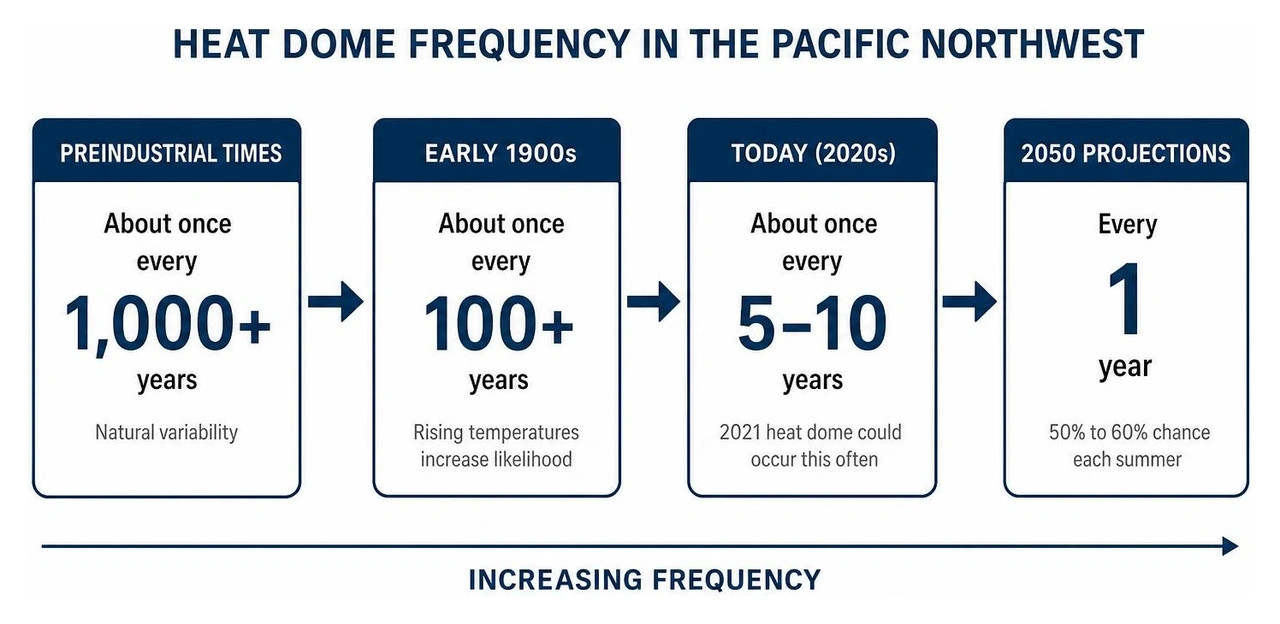
- Human-caused climate change has made events like the 2021 heat dome at least 150 times more likely than in a preindustrial world
- Average temperatures in Washington and Idaho have risen nearly 2°F since 1900, and Oregon by 2.5°F
- Seattle and Portland now experience four to six more heat waves per year than historical baselines show
- The 2021 heat dome — once estimated as a 1-in-1,000-year event — could occur every 5 to 10 years if global warming reaches 2°C
- The hottest days are projected to warm faster than average summer days, meaning heatwaves will outpace general warming trends
- By 2050, there is a 50% to 60% chance the region experiences summer temperatures similar to 2021 every single year
When Skamania County temperatures shot past 110°F during the 2021 heat dome, the region was caught completely off guard. Hundreds of people died. Emergency rooms were overwhelmed. Power lines melted. A small Canadian village called Lytton set a national temperature record of 121.3°F — and then burned to the ground the following day.
This was not a fluke. Tree-ring records stretching back over 1,000 years show that the summer of 2021 was the warmest the Pacific Northwest has experienced since 950 CE. The science is clear: what once felt like a once-in-a-lifetime event is becoming a recurring summer reality for homeowners across the region.
For residents of Kitsap and Jefferson Counties — where many homes were built without air conditioning because the climate historically did not require it — understanding this shift is the first step toward protecting your family.
Anatomy of the 2021 Heat Dome: An Unprecedented Regional Crisis
To understand why our summers are changing, we have to look back at the historic June 2021 heatwave. Across Washington, Oregon, and British Columbia, local weather stations didn't just break records; they completely shattered them. Portland reached an astonishing 116°F, Seattle-Tacoma International Airport hit 108°F, and inland areas across Washington climbed to 120°F.
What made this event so extreme was a phenomenon known as a "heat dome." In meteorological terms, this occurs when a persistent, extraordinarily strong ridge of high pressure stalls over a region. During late June 2021, geopotential height anomalies at 500 hPa reached 5,984 meters over southern British Columbia—an incredible 356 meters above the historical June average.
This massive high-pressure system acted like a lid on a pot, trapping hot air underneath it. As the air sank, it compressed and warmed adiabatically (a process called subsidence), warming the ground further. This was compounded by a severe lack of soil moisture, which meant there was very little evaporative cooling to take the edge off the heat.
The catastrophic impacts of this atmospheric engine are detailed in Unprecedented 21st century heat across the Pacific Northwest of North America , which highlights how this single event redefined our understanding of regional climate vulnerability.
Historical Context: How Extreme Heat Events Are Becoming More Frequent in the Northwest Compared to the Past
For generations, Western Washington residents took pride in not needing air conditioning. A box fan in the window for three days in July was usually enough to get by. However, looking at the long-term historical record reveals that our baseline has shifted permanently.
By analyzing a 1,072-year temperature reconstruction using tree-ring latewood blue intensity, scientists have compared modern Pacific Northwest summers to historical periods like the Medieval Climate Anomaly (950–1250 CE). The findings are startling: average summer temperatures in 2021 were the warmest since 950 CE. In fact, the period of 1979–2021 has averaged 1.27°C above the 1951–1980 baseline, making it the warmest 43-year period in the last millennium.
According to a rigorous Analysis of climate change attribution, an event of the 2021 heat dome's magnitude was virtually impossible in a preindustrial climate. Today, because of human-caused greenhouse gas emissions, the event was not only possible but was estimated to be about 2°C (3.6°F) hotter than it would have been at the start of the industrial revolution.
The Science of How Extreme Heat Events Are Becoming More Frequent in the Northwest
Many homeowners ask us if the 2021 heat dome was just a rare, freak occurrence. Unfortunately, the math says otherwise. The relationship between rising average global temperatures and extreme heatwaves is exponential, not linear.
A local mean temperature increase of just 0.5°C to 1°C can actually double the odds of experiencing a historically rare 50-year extreme heat event. Because North America is warming faster than the global average, the "doubling time scale" for extreme heat risks is accelerating rapidly. Between 2000 and 2050, the risk was doubling roughly every 17 years; between 2025 and 2075, that rate is projected to shrink to a doubling every 13 years.
Furthermore, we are experiencing a phenomenon where our hottest summer days are warming at an accelerated rate compared to our average summer days. This divergence is explained in The Relative Warming Rates of Heat Events and Median Days in the Pacific Northwest from Observations and a Regional Climate Model . In Western Washington, this is largely driven by local geography and the behavior of the West Coast thermal trough (WCTT).
When high pressure builds east of the Cascades, it forces hot, dry continental air westward over the mountains. As this air descends the western slopes toward communities like Bremerton, Port Orchard, and Poulsbo, it compresses and heats up rapidly, overriding the cooling marine influence of Puget Sound. To learn more about how these localized weather shifts impact your property, read our guide on How Kitsap Peninsula Climate Affects Your Home Systems.
Meteorological Drivers: Heat Domes, Soil Moisture, and Atmospheric Rivers
While we often focus on the high-pressure ridge itself, the ingredients that cook up a historic Northwest heatwave often start thousands of miles away.
- Tropical Forcing: High-pressure ridges are often initiated by a trans-Pacific Rossby wave train—essentially a giant atmospheric ripple—triggered by the East Asian monsoon and moisture anomalies in the Philippine Sea.
- Upstream Atmospheric Rivers: Ahead of the heatwave, an intense atmospheric river transports high concentrations of moisture poleward toward the Gulf of Alaska. As this moisture condenses in extratropical cyclones upstream, it releases massive amounts of latent heat, which physically amplifies and reinforces the downstream high-pressure block over our region.
- Soil Moisture Feedback: Heading into June 2021, regional soil moisture levels were at just 50% to 75% of normal. Because the ground was incredibly dry, the sun's energy went directly into heating the air (sensible heating) rather than evaporating water (latent heating). This dry-soil feedback loop amplified peak temperatures by up to 5°C in certain areas.
To explore how these complex, large-scale atmospheric pathways are changing, you can read the full study on Projected changes in atmospheric pathways of Western North American heatwaves simulated from high-resolution coupled model simulations .
Ecological and Public Health Impacts of Rising Temperatures
The transition from a temperate climate to one defined by frequent extreme heat has devastating, cascading consequences for both our communities and local ecosystems.
During the 2021 heatwave, the Pacific Northwest suffered a massive public health crisis. There were 1,090 heat-related emergency room visits on a single day (June 28) across Washington, Oregon, and Alaska—a 69-fold increase compared to previous years. The heat dome contributed to an estimated 1,400 deaths across the US and Canada, heavily concentrated among older adults, individuals living alone, and those without functioning home cooling systems.
Beyond heatstroke and dehydration, extreme heat poses hidden medical dangers:
- Medication Instability: High indoor temperatures degrade life-saving medications like insulin, inhalers, thyroid hormones, and epipens, and can compromise the accuracy of medical devices like glucose test strips.
- Mental Health Crises: Emergency room visits for mental health issues spike significantly during prolonged heatwaves, and extreme heat is statistically linked to increases in societal stress and violence.
Our fragile ecosystems are also bearing the brunt of these temperature spikes. Marine heatwaves (like "The Blob") and land-based heatwaves have caused widespread forest canopy scorch, damaging new growth. Transitioning watersheds are shifting from snow-dominated to rain-dominated systems, lowering summer streamflows and raising water temperatures to levels that are fatal to native salmon populations.
Ensuring your home has a safe, climate-controlled zone is no longer just about comfort—it is a critical safety measure. You can read more about how modern cooling systems protect your household in our article on How Adding AC Protects Your Family During Extreme Heat.
Future Projections: How Extreme Heat Events Are Becoming More Frequent in the Northwest by Mid-Century
What does the future hold for Kitsap and Jefferson Counties? Climate models provide a sobering look at the decades ahead.
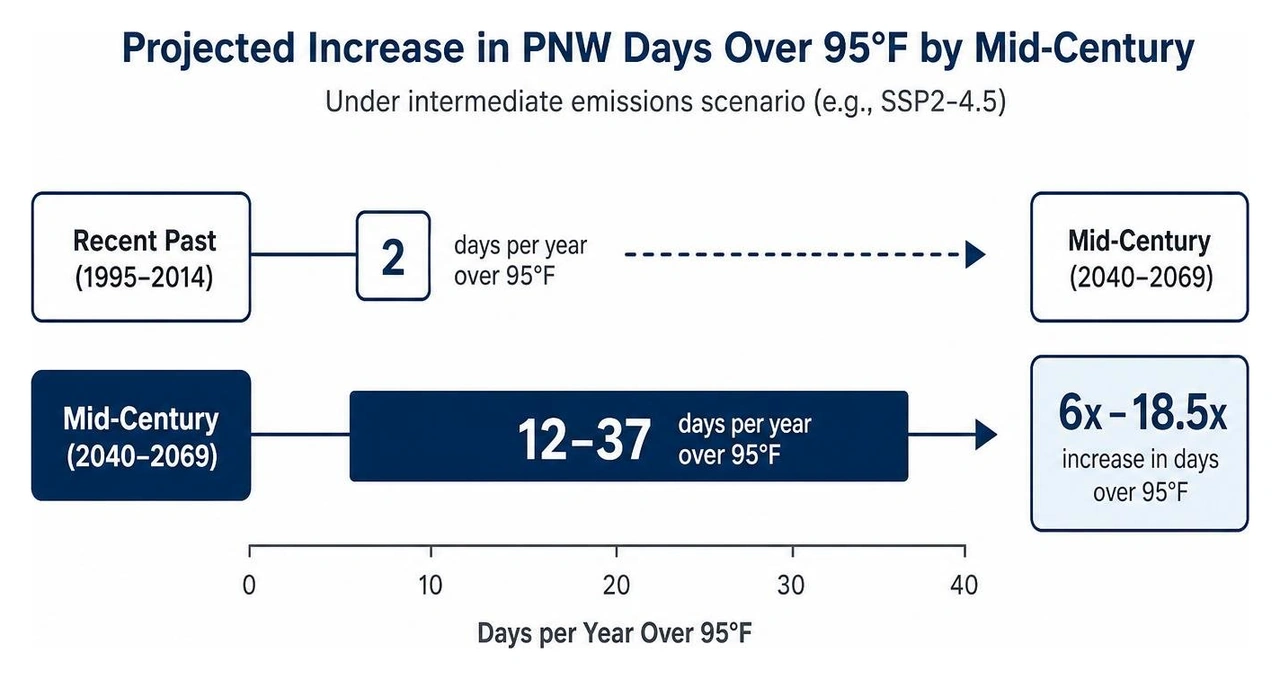
Under intermediate emissions scenarios (such as SSP2-4.5), researchers project that heatwaves with maximum temperatures similar to those in 2021 will become 500% to 17,400% more likely by the middle of the 21st century compared to the recent past.
By the 2080s, average annual temperatures in the Northwest are projected to rise by 4.7°F under low-emissions scenarios, and by up to 10.0°F under high-emissions scenarios. This means that the extreme, record-shattering "anomalies" of yesterday are on track to become baseline, annual summer realities. For a comprehensive breakdown of these regional projections, consult the Fifth National Climate Assessment 27. Northwest .
Infrastructure Vulnerabilities and Regional Policy Responses
The rapid acceleration of extreme heat has exposed major gaps in our regional infrastructure, which was built for the cooler climate of previous decades.
Historically, Western Washington had some of the lowest rates of residential air conditioning in the country. When extreme heat strikes, our homes act like greenhouses, trapping heat indoors overnight and offering no relief to the human body. Additionally, our urban areas suffer from the urban heat island effect; due to a lack of tree canopy and an abundance of asphalt, historically redlined urban neighborhoods can experience surface temperatures up to 13°F warmer than a city's average.
In response to these growing threats, state and local governments have begun implementing regulatory changes. Washington and Oregon have established pioneering state-level regulations to protect outdoor construction and agricultural workers from heat-related illnesses. Municipalities are also updating building codes to encourage heat resilience.
To help you visualize how quickly our local climate is shifting, here is a comparison of historical baselines against future mid-century projections:
| Climate Metric | Historical Baseline (Pre-1990) | Projected Mid-Century (c. 2050) |
|---|---|---|
| Annual Heatwaves (Seattle/Portland) | Baseline average | 4 to 6 additional heatwaves per year |
| Probability of a 2021-style Heat Dome | Virtually impossible (1-in-1,000 years) | Occurs every 5 to 10 years (at 2°C warming) |
| Days Above 95°F (Inland NW) | Historical norm | 19 to 20 additional days per year |
| Average Northwest Temperature | Historical baseline | Up to 4.7°F to 10.0°F warmer |
As summers grow hotter, transitioning to energy-efficient cooling is the most effective way to secure your home. Modern heat pumps are perfectly suited for our marine climate, providing highly efficient cooling in the summer and steady, clean warmth in the winter. Discover how these systems work in our guide on Heat Pump Benefits for Pacific Northwest Homeowners, and learn how to get your home ready for the hot months ahead by reading about Preparing Your Cooling System for Warmer Weather.
Frequently Asked Questions About PNW Heatwaves
How hot did it get during the 2021 Pacific Northwest heat dome?
During the peak of the late June 2021 heat dome, Portland, Oregon reached an all-time record high of 116°F. Seattle-Tacoma International Airport hit an unprecedented 108°F, exceeding its previous record high by 2.8°C. Nationally, Washington State recorded an all-time high of 120°F near Hanford, while the village of Lytton, British Columbia set a Canadian national record of 121.3°F before tragically being destroyed by a wildfire the following day.
Why is the Pacific Northwest so vulnerable to extreme heat?
Our vulnerability is both structural and cultural. Because of our historically mild, temperate summers, Western Washington has had very low residential air conditioning penetration. Older homes were designed to trap heat to keep residents warm during damp winters, lacking the insulation and ventilation systems needed to reject extreme summer heat. Additionally, regional infrastructure—such as municipal water systems, road pavements, and overhead power lines—was not engineered to withstand sustained temperatures over 100°F.
How does climate change affect the frequency of heat domes?
Climate change increases both the baseline temperature of our planet and the behavior of the atmospheric systems that create heatwaves. As global average temperatures rise, the baseline from which heatwaves begin is elevated, making extreme temperatures much easier to reach. Furthermore, warming in the Arctic and changes in tropical weather patterns alter the jet stream, making large-scale atmospheric patterns like "Omega blocks" and Rossby wave trains more persistent, which causes heat domes to stall over regions for longer periods.
Prepare Your Home for a Changing Climate with Eagle Pipe Mechanical
At Eagle Pipe Mechanical, we believe that preparing your home for rising summer temperatures shouldn't be stressful. We are a 100% women-owned and operated HVAC and plumbing contractor with over 45 years of experience serving homeowners across Kitsap and Jefferson Counties—including Poulsbo, Bainbridge Island, Port Townsend, Silverdale, and Bremerton.
Whether you want to upgrade to a high-efficiency heat pump, add a ductless mini-split to an older home, or ensure your existing system is ready to handle a summer heatwave, our team of EPA and NATE-certified technicians is here to help. We hold federal and state certifications, a City of Seattle Mechanic's license, and offer flexible financing options through Synchrony to make home comfort upgrades accessible.
To keep your systems running at peak efficiency year-round, we also offer our Eagle's Nest maintenance plan, featuring comprehensive 37-point inspections, priority customer status, extended warranties, and exclusive repair discounts. Please note that while we do not offer 24/7 emergency services, we are committed to providing honest, dependable, and highly efficient scheduled solutions tailored to your unique needs.
Don't wait for the next major heatwave to compromise your family's comfort and safety. Schedule professional air conditioning services with Eagle Pipe Mechanical today, and let us help you build a more resilient home.
CUSTOMER TESTIMONIALS
Our customers’ experiences say more than we ever could. See how Eagle Pipe Heating & Air has earned trust across the Pacific Northwest with reliable service and lasting results.