When to Call a Professional for AC Problems
Why Knowing When to Call a Professional for AC Problems Can Save Your System
Knowing when to call a professional for AC problems is one of the most important things you can do to protect your home comfort — especially during the warm months in Kitsap and Jefferson County, Washington. Most AC systems don't fail without warning. They give you signals first. The trouble is, not every sign is obvious, and waiting too long to act can turn a minor fix into a costly repair or full system replacement.
Here's a quick guide to when you need a professional:
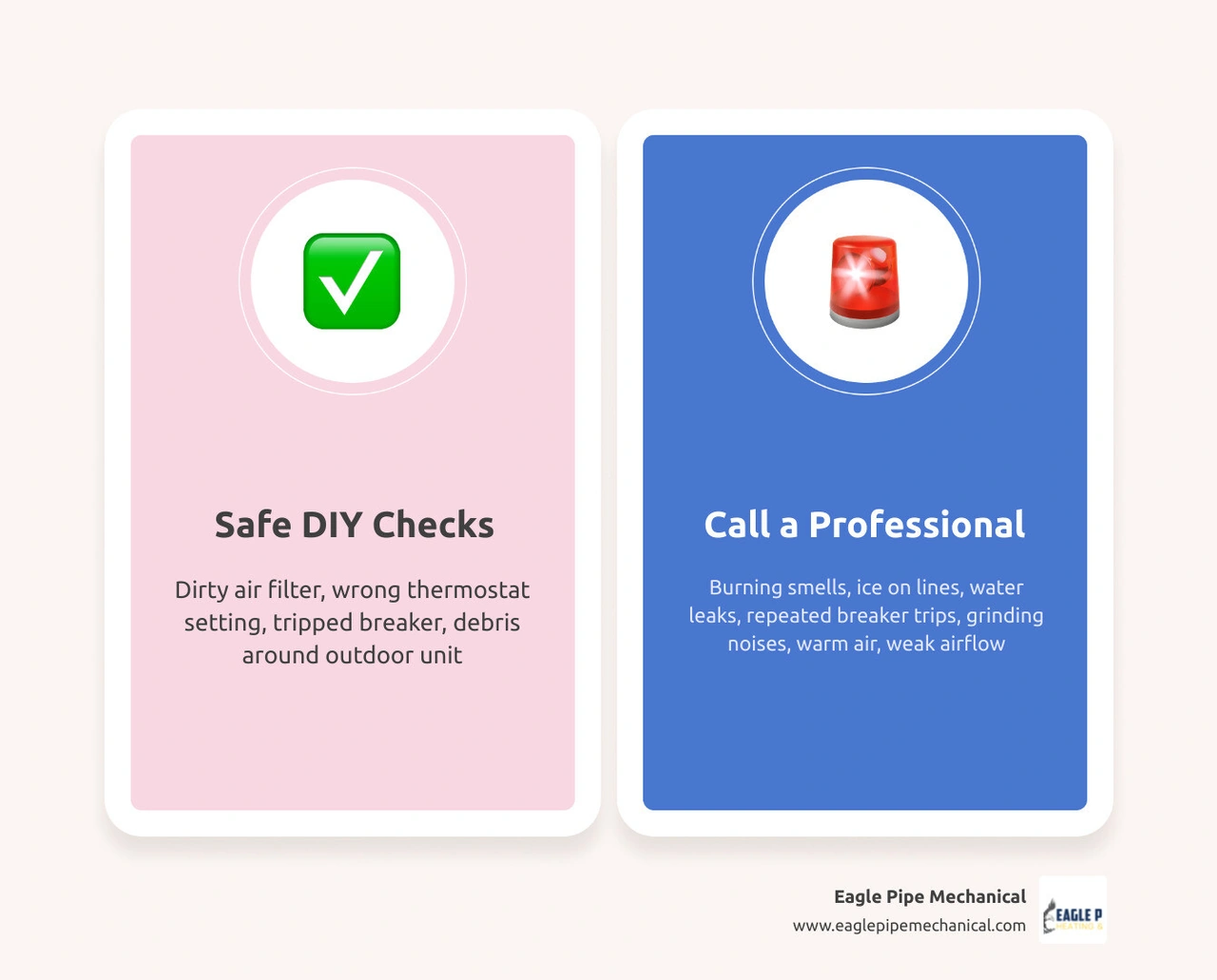
- Call a professional right away if you notice: burning smells, ice on the refrigerant lines, water leaking from the indoor unit, repeated circuit breaker trips, or loud grinding and banging noises
- Schedule a service call soon if you have: warm air blowing despite correct thermostat settings, weak airflow, short cycling (system turning on and off frequently), or a sudden spike in your energy bill
- Try basic DIY checks first for: a dirty air filter, incorrect thermostat settings, a tripped breaker, or debris blocking the outdoor unit
Some AC issues are simple enough that a homeowner can resolve them in minutes. Others involve high-voltage electrical components, pressurized refrigerant, or a failing compressor — repairs that require a licensed HVAC technician with the right tools and certifications. Attempting those repairs yourself risks injury, further damage to your system, and even a voided manufacturer warranty.
In this guide, we'll walk you through exactly what you can safely check yourself, which warning signs mean it's time to call in the pros, and how regular maintenance keeps those urgent calls to a minimum.
Safe DIY Checks to Perform Before Calling a Technician
Before you pick up the phone to schedule a service call, there are a few basic homeowner troubleshooting steps you can perform. It is not uncommon for a "broken" air conditioner to simply be the victim of a minor oversight. Taking ten minutes to run through these safe checks can save you time and prevent unnecessary service appointments.
However, it is crucial to know your limits. Homeowner maintenance should focus only on external, non-invasive tasks. Anything that requires opening the cabinet of your indoor air handler or outdoor condenser unit, handling electrical wiring, or touching the refrigerant lines should be left to a licensed professional.
To help you distinguish between what is safe to do yourself and what requires expert hands, review this comparison table:
| DIY Homeowner Checks | Professional HVAC Tasks |
|---|---|
| Checking and replacing the air filter | Diagnosing electrical failures and replacing circuit boards |
| Adjusting thermostat settings and replacing batteries | Repairing or recharging refrigerant leaks |
| Checking for a tripped circuit breaker (resetting once) | Replacing a failing compressor or fan motor |
| Clearing leaves, weeds, and debris from around the outdoor unit | Cleaning deeply impacted evaporator and condenser coils |
| Ensuring all indoor supply vents and return grilles are open | Inspecting, sealing, and repairing ductwork leaks |
Checking Your Thermostat and Power Settings
If your system won't turn on at all, the issue might not be a mechanical failure. Start by checking your thermostat. Ensure it is set to "Cool" and that the temperature setting is at least a few degrees below the current room temperature. If the screen is blank, replace the batteries.
Next, verify that the system is actually receiving power. Check the outdoor disconnect switch (usually located in a metal box on the wall near your outdoor unit) and the indoor power switch (often resembling a standard light switch near your furnace or air handler) to ensure they are both in the "On" position. Finally, head to your home's electrical panel and check for a tripped circuit breaker. If the breaker has tripped, reset it once. If it immediately trips again, do not force it; this indicates an electrical issue that requires professional attention. For more detailed steps on resolving a system that refuses to start, check out our guide on AC Won't Turn On Solutions.
Inspecting and Replacing Your Air Filter
A clogged air filter is the single most common cause of air conditioning issues. When a filter is heavily loaded with dust, pet dander, and debris, it restricts airflow through the system. This restriction forces your blower motor to work much harder, decreasing system efficiency and putting unnecessary strain on internal components.
Over time, severe airflow restriction can even cause your evaporator coils to freeze over, leading to a complete system shutdown. We recommend inspecting your air filter once a month and replacing it every one to three months, especially during seasons of heavy use. Understanding this simple maintenance task is easier when you know How Your Air Conditioner Works to pull warm air out of your home and distribute cool, filtered air back inside.
When to Call a Professional for AC Problems
While basic troubleshooting can resolve minor issues, most complex performance problems require professional HVAC repair. Modern air conditioners are highly sophisticated machines containing pressurized gases, high-voltage electrical circuits, and sensitive electronics. Recognizing the warning signs of a deeper issue early on can prevent a complete system breakdown during a Pacific Northwest summer.
If you live in Poulsbo, Kingston, Hansville, Belfair, Indianola, Bainbridge Island, Silverdale, Port Ludlow, Port Townsend, Port Hadlock, Port Orchard, Bremerton, Gig Harbor, Seabeck, or Suquamish, our team at Eagle Pipe Mechanical is always ready to help you diagnose and resolve these complex issues.
Recognizing When to Call a Professional for AC Problems Regarding Airflow
If your air conditioner is running but you notice weak airflow or warm air blowing from your vents, it is a clear sign that something is wrong. Weak airflow often points to an issue with the blower fan or the fan motor itself. Over time, fan motors can wear out, lose lubrication, or suffer from electrical failures.
Warm air blowing from the vents, on the other hand, can indicate a variety of problems, ranging from dirty coils to a failing compressor. If you have already verified that your thermostat is set correctly and your air filter is clean, yet your home remains uncomfortably warm, you are likely dealing with a problem that requires expert diagnostic tools. You can read more about identifying these issues in our article on Signs You Need Immediate AC Repair or learn how we address blower issues by reading about Fixing AC Fan Motor Performance Issues.
When to Call a Professional for AC Problems Involving Electrical Components
Electrical issues are among the most hazardous AC problems a homeowner can encounter. If your system is repeatedly tripping the circuit breaker, do not keep resetting it. This is a safety mechanism designed to prevent electrical fires, and repeated trips usually indicate a short circuit, a failing compressor, or a bad run capacitor.
Capacitors store high-voltage electricity to help start and run the motors in your AC. Even when the power to your system is turned off, these capacitors can hold a lethal electrical charge, which is why they should only be handled by certified technicians. Additionally, if you notice clicking sounds when your system tries to start, or if you suspect your control board is malfunctioning, it is time to bring in the experts. Learn more about these warning signs by reading about Silverdale AC Circuit Board Is Failing Signs and exploring the common AC Clicking Sounds Reasons.
Dealing with Refrigerant Leaks and Frozen Coils
Your air conditioner relies on a precise amount of chemical refrigerant to absorb heat from your indoor air and transfer it outside. If your system develops a leak, its cooling capacity will drop significantly. You might notice hissing or bubbling sounds coming from the refrigerant lines, or you might see ice building up on the outdoor copper lines and the indoor evaporator coils.
Frozen evaporator coils are a major red flag. When ice forms, it acts as an insulator, preventing the refrigerant from absorbing heat and causing the system to run constantly without cooling. Attempting to add refrigerant yourself is not only highly dangerous due to the high pressures involved, but it is also illegal without proper EPA certification. To understand why these leaks happen and how to spot them, check out our guides on Common AC Refrigerant Leak Causes and AC Refrigerant Leak Signs.
The Risks of Ignoring AC Issues or Attempting Complex DIY Repairs
It can be tempting to search for a quick tutorial online and attempt to repair your air conditioner yourself. However, DIY repairs on complex HVAC systems carry significant risks. First and foremost is the danger of personal injury. Working with high-voltage electricity, moving fan blades, and chemical refrigerants requires specialized safety gear and training.
Beyond the physical danger, DIY attempts often lead to more extensive and costly damage. For example, ignoring a minor refrigerant leak or an electrical issue can put immense strain on the compressor — the "heart" of your air conditioning system. When a compressor fails, it often leads to complete compressor burnout, which frequently necessitates a full system replacement rather than a simple repair.

Furthermore, almost all HVAC manufacturers require that their systems be installed, maintained, and repaired by licensed, certified professionals. If you attempt a DIY repair and damage an internal component, you will likely void your manufacturer warranty, leaving you fully responsible for the cost of future repairs. If your system is making strange noises, such as grinding, clanging, or squealing, it is a clear warning that parts are failing. Instead of trying to open the cabinet yourself, protect your investment by scheduling a professional diagnostic visit. You can read more about these mechanical warning signs in our article on what to do when your AC Making a Grinding Noise.
Preventing Major Breakdowns with Regular Maintenance
The best way to handle AC problems is to prevent them from happening in the first place. Just like your car, your air conditioning system requires regular professional maintenance to operate at peak efficiency and reliability. Scheduling an annual tune-up — ideally in the spring before the summer heat arrives — is the single most effective step you can take to protect your system.
During a professional maintenance visit, a certified technician will thoroughly inspect your entire system. They will clean the evaporator and condenser coils, check refrigerant levels, test electrical connections, lubricate moving parts, and verify that the thermostat is communicating correctly with the system.
This proactive approach allows technicians to identify and resolve minor wear-and-tear issues before they escalate into major, expensive breakdowns during the hottest days of the year. Regular maintenance also keeps your system running as efficiently as possible, which helps keep your monthly energy bills low and extends the overall lifespan of your equipment.
At Eagle Pipe Mechanical, we make proactive care simple with our Eagle's Nest maintenance plan, which includes comprehensive multi-point inspections, priority status, and repair discounts. To learn more about the long-term benefits of professional care, read our guides on why you should Trust Experts for AC Maintenance and explore our Essential Guide to AC Maintenance.
Frequently Asked Questions About AC Troubleshooting
We understand that dealing with air conditioning issues can be stressful. To help you navigate these situations, we have compiled answers to some of the most common questions homeowners ask about AC troubleshooting and professional service.
Why is my AC blowing warm air?
If your air conditioner is blowing warm air, start by verifying that your thermostat is set to "Cool" and the fan is set to "Auto" rather than "On" (which runs the fan continuously even when the system isn't actively cooling). If those settings are correct, check your air filter; a severely clogged filter can restrict airflow and cause the system to malfunction.
If the filter is clean, the issue is likely a dirty outdoor condenser coil, a refrigerant leak, or a failing compressor. Because these components rely on a delicate balance of airflow and pressure, resolving these issues requires a professional touch. You can learn more about how these parts interact by reading about How Your Indoor and Outdoor AC Units Work Together.
How often should I schedule professional AC maintenance?
You should schedule professional AC maintenance at least once a year. The best time for this service is in the early spring, before you need to rely on your system daily. A spring tune-up ensures that your air conditioner is clean, efficient, and ready to handle the summer heat without unexpected interruptions.
Regular annual maintenance not only prevents emergency breakdowns but also preserves your manufacturer warranty and helps extend the lifespan of your system. To get your cooling system ready for the warmer months, take a look at our helpful guide on how to Prepare Your AC for Spring.
Can low refrigerant be fixed without a technician?
No, low refrigerant cannot be fixed without a licensed technician. Air conditioners do not "consume" refrigerant; they reuse the same charge continuously. If your system is low on refrigerant, it means there is a leak in the closed loop. Simply adding more refrigerant without finding and repairing the leak is a temporary fix that wastes money and harms the environment.
Furthermore, handling refrigerants requires specialized tools, leak detection equipment, and EPA Section 608 certification, which is legally required to purchase and handle these chemicals. If you suspect a leak, always call a professional. For a foundational look at how these systems manage temperature, read our overview of the Basics of Air Conditioning Systems.
Conclusion
Knowing when to call a professional for AC problems is the key to maintaining a comfortable, safe, and energy-efficient home. While simple tasks like changing your air filter and adjusting your thermostat are perfectly safe for homeowners, complex mechanical, electrical, and refrigerant issues require the expertise of licensed professionals.
When you need reliable, professional support, you can count on Eagle Pipe Mechanical. As a 100% women-owned and operated business with over 45 years of combined experience, we are proud to serve families and businesses across Kitsap and Jefferson Counties — including Poulsbo, Kingston, Hansville, Belfair, Indianola, Bainbridge Island, Silverdale, Port Ludlow, Port Townsend, Port Hadlock, Port Orchard, Bremerton, Gig Harbor, Seabeck, and Suquamish.
We are committed to providing honest, knowledgeable, and efficient service. Whether you need a quick repair, a seasonal tune-up, or are considering a system upgrade, we offer personable solutions tailored to your specific needs. Plus, we offer flexible financing options through Synchrony to ensure your home comfort fits comfortably within your budget.
Don't wait for a minor issue to turn into a major breakdown. If your air conditioner is struggling, reach out to us today to schedule an appointment with our expert team, and visit our Eagle Pipe Mechanical Air Conditioning Services page to explore how we can keep your home cool and comfortable all summer long.
CUSTOMER TESTIMONIALS
Our customers’ experiences say more than we ever could. See how Eagle Pipe Heating & Air has earned trust across the Pacific Northwest with reliable service and lasting results.